
Responsible Football Prediction: Using AI Probabilities Without Guarantees

Quick answer: Responsible football prediction means treating every AI forecast as a probability, not a promise, and pairing it with clear disclaimers, realistic accuracy expectations, and safeguards against harmful gambling behavior. No match forecast should be read as a guarantee of profit or an invitation to bet.
> Definition: Responsible football prediction is the practice of presenting AI-generated match probabilities and score forecasts as informational tools, accompanied by transparent disclaimers, honest accuracy reporting, and safeguards that discourage risky gambling behavior.
TL;DR
- Every prediction on this site is a probability, never a guaranteed outcome.
- AI models have real limits: overfitting, data decay, and irreducible match variance.
- We separate football analytics from betting promotion and provide responsible-gambling resources.
- Only 5–10% of sports bettors show consistent net profits over time.
- No disclaimer replaces personal responsibility, stake only what you can afford to lose.
What This Responsible Prediction Policy Covers
Responsible prediction covers how match probabilities, score forecasts, and confidence ratings are written, displayed, updated, and limited. It applies to all AI probabilities, correct score views, BTTS reads, over-under outlooks, and confidence meters published by Football Prediction.
The policy is simple: football analytics are informational only. They are not financial advice, betting advice, or a call to place a wager. A 61% home-win probability still leaves a large losing branch. Anyone who has watched a 1-0 tile flip in stoppage time knows that.
No forecast content is intended for minors. The site follows a strict 18+ or local legal-age standard and does not target vulnerable users, underage fans, or people struggling with gambling harm.
Analytics content must also stay separate from bookmaker promotion. That means probability reports, not betting pushes. For a wider risk explainer, read betting risks in football prediction.
How Responsible Football Forecasting Works
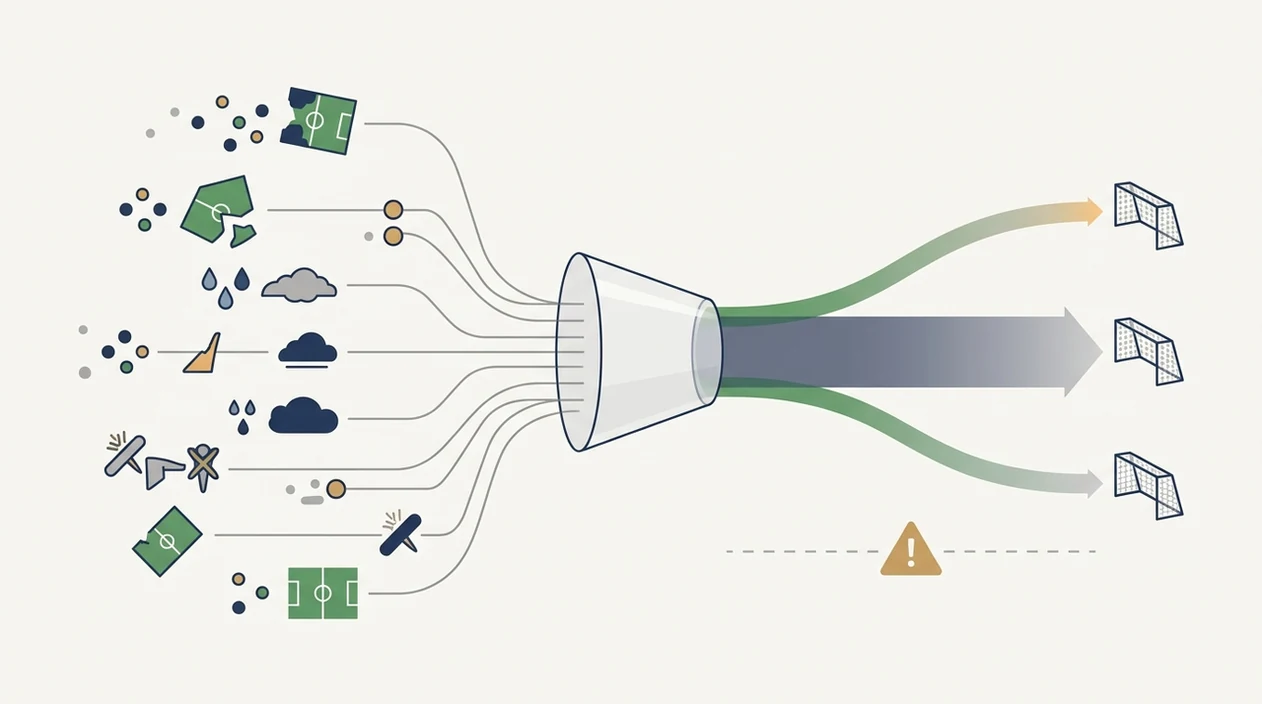
Responsible football forecasting works by converting match data into probabilities, then surrounding those probabilities with limits, context, and plain-language warnings. The output is a range of likely outcomes, not a hidden certainty.
From Historical Data to Match Probability
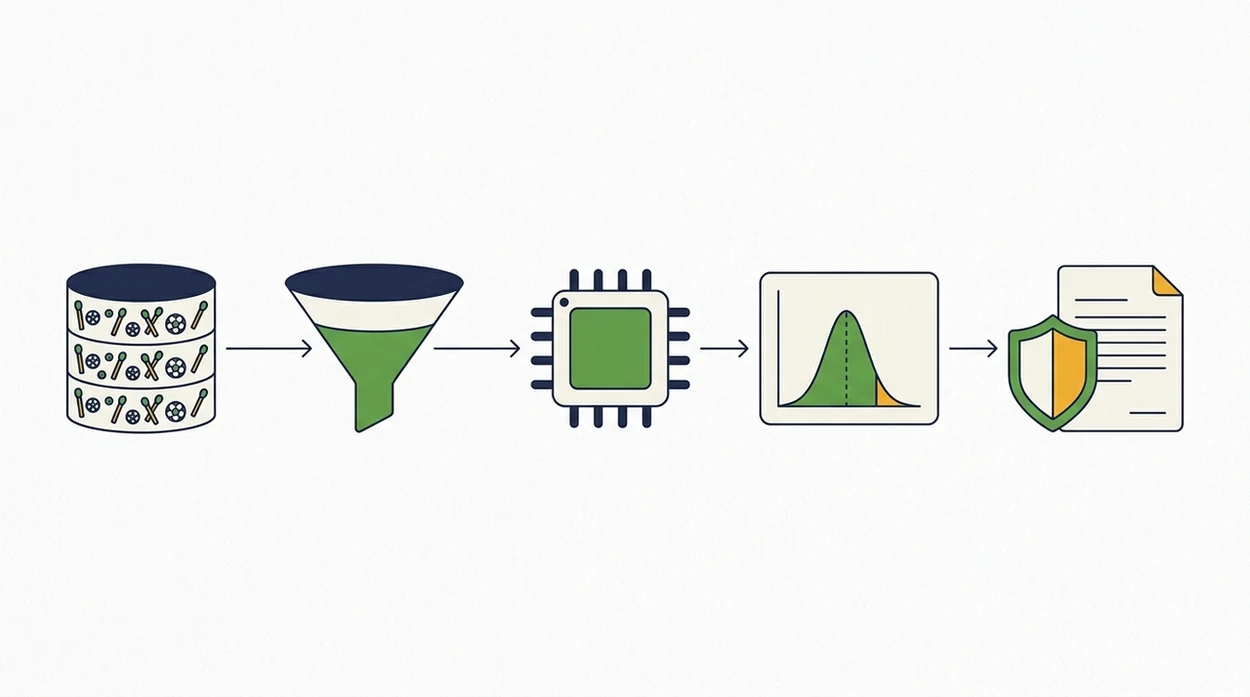
AI models ingest results, xG, shot quality, home advantage, rest gaps, injuries, league strength, and fixture congestion. A Poisson model may estimate goal counts from expected goals; calibration checks whether stated probabilities match later outcomes. If 100 matches are rated 60%, roughly 60 should land over time.
The team sheet still matters. A missing full-back an hour before kickoff can change the BTTS read because the press resistance and wide coverage both shift.
Built-In Safeguards Against Misleading Language
Confidence ratings reflect statistical likelihood, not a “lock” or “sure win.” Reviews of prediction models show that complex AI systems can overfit and perform worse than simpler baselines when tested prospectively, according to Nature Digital Medicine source.
Use forecasts this way:
- Check today’s fixtures and note the published probability, not only the headline pick.
- Review the model factors such as injuries, xG trend, rest, and home advantage.
- Compare score distributions before treating 1-0, 2-1, or 1-1 as realistic.
- Read the disclaimer before using any forecast for decisions.
- Walk away if the prediction makes you feel pressured to bet.
Good AI football prediction tools deliver probability context and model limits, not guaranteed wins or emotional betting prompts.
Five Facts Every Fan Needs About Safe Football Forecasting
- Predictions are probabilities, not profit guarantees. A 70% model edge still fails often because football has red cards, deflections, missed penalties, and low-scoring variance.
- Past data can decay fast. Transfers, injuries, tactical switches, and new managers can make last month’s xG profile less useful by kickoff. The recent xG trend line rising is useful, but it is not prophecy.
- Most bettors do not show long-term profit. A U.S. study found only 5–10% of sports bettors showed consistent net profits over time source.
- Younger adults face higher gambling risk. UK government survey data reports higher problem-gambling rates among 18–24-year-olds, especially around online sports betting source.
- Disclaimers need matching tone. A prediction disclaimer is weakened if the surrounding page shouts “sure win,” “banker,” or “lock.”
For most fans, probability ranges are safer than single-score certainty because they show how much uncertainty remains before kickoff.
Specific Guarantees Football Prediction Makes to Users
Football Prediction makes specific responsible-use commitments for every forecast format, including match score prediction, confidence ratings, and football prediction today pages.
- No guarantee language. We do not use “sure win,” “lock,” “banker,” or similar language in prediction content.
- Visible prediction disclaimer. Every forecast page states that outputs are informational only and not betting advice.
- Realistic accuracy reporting. Published accuracy metrics are backward-looking, updated, and explained with the note that past accuracy does not guarantee future performance. The detailed method sits in football prediction accuracy.
- No bookmaker promotion. Forecast pages do not carry bookmaker affiliate links or betting-promotion copy.
- Independent support resources. Where relevant, pages point users toward responsible-gambling help, including GamCare, NCPG, and local services.
- Age controls. The site applies an 18+ or local legal-age gate.
Small line, big difference.
Tools like AI Soccer Predictor can be useful when they explain uncertainty, but the forecast still needs a clear stop sign around gambling harm.
What This Prediction Disclaimer Does Not Cover
A prediction disclaimer explains limits, but it cannot control personal gambling decisions. It cannot guarantee harm-free use, stop someone from chasing losses, or make a volatile 2-1 forecast safer than it is.
Some users ignore disclaimers and look only at the headline pick. That is why safe football forecasting has to shape the whole page, not only the legal text at the bottom. The wording, confidence meter, score forecast, and notification style all matter.
Responsible messaging may reduce harm, but it cannot fully protect people already struggling with addiction. Pew Research reported that 19% of U.S. sports bettors said they had bet more than they could afford to lose at least sometimes, and 21% had felt guilty about gambling source.
Football Prediction is not a licensed gambling operator. It does not accept stakes, process bets, settle markets, or provide regulated gambling services. Users needing support should start with responsible gambling for football fans.
When to Seek Gambling Support
Seek gambling support as soon as football forecasts stop feeling like harmless information and start feeling hard to switch off. Warning signs include chasing losses, hiding bets, feeling guilt after gambling, borrowing money, or checking predictions with a sense of pressure rather than curiosity.
If control feels difficult, stop using prediction content before the next fixture pulls you back in. Football Prediction can explain probabilities and disclaimers, but it cannot provide medical advice, legal advice, financial advice, or gambling-treatment support.
- Pause prediction pages, alerts, and score-checking routines if they are linked to urges to bet.
- Tell someone you trust what is happening, especially if secrecy has become part of the pattern.
- Contact an independent service such as GamCare, NCPG, or a local gambling helpline in your country.
- Limit access to money, accounts, or betting apps while you arrange support.
- Seek urgent help immediately if you may harm yourself or someone else, feel unsafe, or cannot stop an escalating gambling episode.
A missed match is nothing compared with protecting your health, safety, and relationships.
Common Myths About Responsible Football Prediction
Myth: “Responsible prediction” means safer bets that rarely lose. Reality: responsible prediction means the messaging is honest. It does not make the match outcome more certain.
Myth: AI automatically makes forecasts accurate enough for larger stakes. Reality: AI can outperform or underperform human judgment depending on data quality, calibration, and freshness. Overfitting is real. The model can learn yesterday’s noise.
Myth: A disclaimer alone protects users. Reality: tone and framing matter as much as legal text. A page cannot responsibly say “informational only” in one line and “banker” in the next.
Myth: Sites that do not take bets have no responsibility. Reality: content creators influence user behavior. A supporter checking odds at lunch can be nudged toward caution or toward risk.
For fans comparing AI football prediction accuracy results, the key question is not only “did it win?” It is whether the stated probability matched the real long-run outcome.
How to Contact Football Prediction About This Policy
Users can contact Football Prediction about this policy through the site contact form or by emailing the support address listed on the contact page. Use that channel for disclaimer questions, accuracy concerns, data-removal requests, or reports of harmful prediction wording.
You can also request removal from betting-related notifications or ask to opt out of specific content categories. We aim to respond within 5 working days, with urgent safety concerns reviewed faster where possible.
If gambling feels difficult to control, do not wait for a site reply. Contact an independent responsible-gambling helpline such as GamCare, NCPG, or a local support service in your country.
AI Soccer Predictor ai football prediction content should never replace support from trained gambling-harm services.
Limitations
Responsible prediction has hard limits, and they should be visible before anyone trusts a forecast.
- No model or tipster, human or AI, can eliminate football variance. Even high-confidence predictions will frequently lose.
- Historical data decays quickly because of transfers, injuries, tactical changes, new competitions, and fixture congestion.
- A centre-back tugging at a hamstring after a recovery sprint may matter more than last season’s clean-sheet rate.
- Responsible practices can reduce harm, but they cannot fully prevent problem gambling in users with existing addiction.
- Probability transparency may be ignored by users who fixate on headline picks or “today prediction” shortcuts.
- Published accuracy is backward-looking. It may not reflect future performance if the model, league, or data source changes.
- Complex AI models can overfit and underperform simpler baselines when tested prospectively, as the Nature review noted.
- Great Britain health survey data estimated adult problem gambling prevalence around 0.3–0.5%, with 3.8% at moderate risk source.
A probability report is useful only when the reader accepts uncertainty.
For match models, the football prediction track record should be read as historical evidence, not a promise about the next fixture.
FAQ
Can AI guarantee football match outcomes?
No AI model can guarantee a football result. Every output is a probability affected by variance, injuries, red cards, and late team news.
Are football predictions financial advice?
No. Football predictions are informational football analytics, not regulated financial advice, betting advice, or instructions to wager.
What does a prediction disclaimer mean?
A prediction disclaimer states that forecasts are uncertain and for information only. It reminds users that past accuracy does not guarantee future results.
Do most sports bettors lose money?
Yes, most sports bettors lose money over time. Research has found only 5–10% show consistent net profits across a study period.
Is AI more accurate than human tipsters?
AI can be more accurate or less accurate than human tipsters. Performance depends on model design, data freshness, calibration, and match context.
Who should avoid football prediction content?
Minors, people with gambling addiction, and anyone unable to treat forecasts as entertainment should avoid football prediction content. People chasing losses should stop and seek support.
How is prediction accuracy measured?
Prediction accuracy is measured with calibration, hit rate, scoreline performance, and long-run comparison between forecast probability and actual results. All published accuracy figures are backward-looking.
Where can I get gambling support?
You can contact independent gambling-support services such as GamCare, NCPG, or local responsible-gambling organizations. If gambling feels urgent or unsafe, seek help immediately.