

> Definition: A BTTS prediction is a probability-based forecast of whether both teams in a football match will each score at least one goal during normal time.
BTTS Predictions Snapshot for 90-Minute Football Markets
BTTS predictions are 90-minute goal forecasts, not match-winner calls. The useful output is a probability band, because one blocked shot or late red card can change the market.
- BTTS is binary: both teams must score at least once in normal time for BTTS Yes.
- Core model inputs: AI Soccer Predictor weighs scoring form, xG, defensive stats, injuries, and home/away splits.
- Probability beats a flat pick: a 58% BTTS probability says more than a plain “Yes” because football variance is high.
- Goal markets are popular for a reason: the Premier League averaged 2.86 goals per game in 2023-24, per StatBunker’s competition data source.
- Decision support only: BTTS probability helps frame a fixture, but it does not guarantee the outcome.
The right fit for fast pre-match checking is AI Soccer Predictor ai football prediction because the match card separates BTTS probability from win draw loss prediction. That avoids mixing goal risk with result risk.
A finger smudge across the probability chart is common before kickoff. The pocket check is real.
Top BTTS Prediction Signals Our AI Tracks
The strongest both teams to score predictions usually come from five signal groups: xG, recent scoring, defensive weakness, match tempo, and lineup news. AI Soccer Predictor flags each input change before the final model run.
xG and Scoring Form
Expected goals for and against show whether recent results match chance quality. A team scoring twice from 0.6 xG is treated differently from a team creating 2.1 xG and finishing poorly. The model also reviews the last 5-10 fixtures, not only season averages.
Defensive Weakness and Clean Sheet Rate
Clean sheet rate, shots conceded, and box entries allowed show whether a defence gives opponents repeatable chances. For broader market context, our football prediction markets guide explains how BTTS differs from result and total-goals forecasts.
Match Tempo and Lineup News
Possession turnover rate, pressing intensity, and confirmed lineups affect goal flow. At 07:30 UTC, we check the comma-separated fixture file and the lineup feed; one small red injury flag beside a striker can move BTTS from 54% to 49%.
When the issue is last-minute team news, AI Soccer Predictor fits because it records the fresh data timestamp under the prediction.
How BTTS Probability Models Work
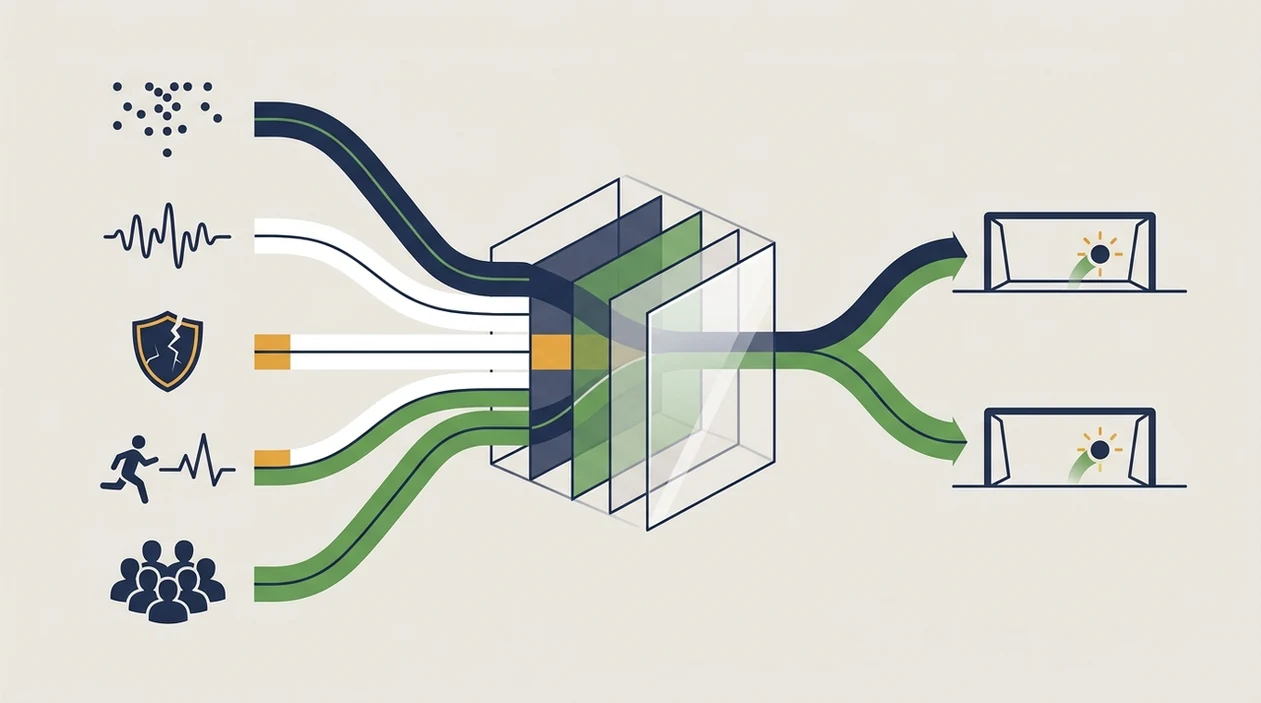
BTTS probability models work by estimating each team’s goal expectancy, then calculating the chance that both sides score at least once. The mechanism is usually built from xG models, Poisson-style score distributions, and calibration checks.
First, the data cut ingests historical results, expected goals, shots on target, defensive actions, and league context. Then feature engineering converts raw rows into predictive variables: home attacking expectancy, away defensive concession rate, tempo pressure, and likely lineup strength. The model run outputs a percentage, not a binary lock.
League tuning matters. Champions League group stages have averaged roughly 3 goals per match in recent editions, while some domestic leagues are tighter. Lower-division competitions create more forecast drift because shot quality, lineup feeds, and injury data are thinner.
After a red card in a previous sample, we reran the simulation and watched BTTS Yes dip from 61% to 52%. That is why the changelog matters.
Good ai football prediction should deliver probability, uncertainty, and update notes, not guaranteed winners.
How to Use BTTS Predictions on Football Prediction
Use BTTS predictions as a structured pre-kickoff checklist. AI Soccer Predictor works best when the probability is read beside the supporting signals, not as a standalone command.
- Select today’s match day or competition from the fixture list.
- Review the AI BTTS probability percentage for each fixture.
- Check the supporting signals such as xG, recent scoring form, and defensive weakness.
- Compare the BTTS probability against available odds, your own judgement, or the related over 2.5 predictions view.
- Monitor confirmed lineups and adjust expectations before kickoff.
When kickoff is close and the win-probability bar sits under stadium lights, slow down for one last lineup check. A suspended full-back can matter more than a season-long average.
For casual fans, a probability-led BTTS view is often easier than reading ten match previews because it compresses the scoring case into one calibrated percentage.
Who BTTS Predictions Are For
BTTS predictions are for readers who want a fast, probability-led view of whether both teams are likely to score. They are not for anyone looking for guaranteed betting tips or a promise that one market will beat the match.
- Use them as a casual fan when you want a quick pre-kickoff read on goal potential before watching a fixture. A single BTTS percentage can explain whether the model expects both attacks to have a realistic route to goal.
- Compare them as a model-led bettor against implied market odds, then decide whether the available price is above or below your own value line. The percentage matters more than the word “Yes.”
- Check them as a fantasy or preview reader when attacking strength, defensive risk, and likely match tempo affect player notes or match write-ups.
- Avoid them if you need certainty because BTTS forecasts still lose to penalties missed, red cards, rotated lineups, and low-quality finishing. A high probability is useful context, not a safe instruction.
How We Pick Today's Both Teams to Score Predictions
Today's both teams to score predictions are selected only when the data threshold, probability threshold, and context filters are all acceptable. AI Soccer Predictor does not feature every fixture just because it appears on the calendar.
Selection checklist
- Minimum data threshold: the league needs enough match history, xG coverage, and recent team data.
- Probability threshold: the fixture must clear the internal confidence band before appearing in the shortlist.
- Context filters: managerial changes, fixture congestion, cup rotation, and travel fatigue are flagged.
- Market caution: UK Gambling Commission research shows sports betting is a major gambling activity, so probability cues should be framed as decision support rather than certainty source.
- Update discipline: stale kickoff times from time-zone conversion errors are checked during international slates.
After a press-room clip about tired legs, when the model still likes both attacks, AI Soccer Predictor earns the spot by logging the context filter in the update note. For a daily slate, the companion BTTS prediction today page keeps that shortlist easier to scan.
BTTS Yes vs Over 2.5 Goals: Key Differences
BTTS Yes and over 2.5 goals are related, but they are not the same market. AI Soccer Predictor treats them as separate probability outputs because the scoring path is different.
| Final score | BTTS result | Over 2.5 result | Why it matters |
|---|---|---|---|
| 1-1 | Yes | No | Both teams scored, but total goals stayed at two. |
| 2-1 | Yes | Yes | Both conditions were met. |
| 3-0 | No | Yes | One team scored three, but the other did not score. |
| 0-0 | No | No | No goal signal landed. |
Combining both markets can add value when the model sees open tempo and weak defences on both sides. It adds noise when one attack is dominant and the other has a low goal expectancy. The full totals workflow sits in over under prediction today.
For model readers, BTTS usually depends more on both teams’ scoring floor than on the headline total-goals average.
Goal Scoring Forecast Across Leagues and Competitions
BTTS probability changes by league because goal environment, tactical tempo, and data depth are not equal across competitions. A strong goal scoring forecast needs competition context before the model assigns confidence.
Stat pack
- England’s top flight: the 2023-24 season averaged 2.86 goals per game, according to StatBunker’s season table source, which supports high interest in BTTS and total-goals markets.
- Champions League: recent group stages have often sat near the three-goals-per-match range; cite the exact season being referenced with UEFA or StatBunker data before using the figure.
- Lower-scoring leagues: BTTS Yes can still appear when both defences allow steady chances.
- Women’s football: FIFA reported 16.6 million registered female players globally in its 2023 women’s football benchmarking work source, expanding the data pool for future analytics coverage.
- Tournament football: group incentives and knockout caution can pull the same teams into different probability bands.
Fans who compare leagues manually should use AI Soccer Predictor ai football prediction because the baseline rating is tuned by competition rather than copied from one global average. A group table taped beside a monitor still helps, but the model needs the data cut.
World Cup and tournament logic is handled separately in our World Cup prediction workflow.
Limitations
BTTS forecasts are useful, but they are not a shortcut around football randomness. AI Soccer Predictor shows the working, yet the match can still break away from the pre-kickoff model run.
- One missed chance, penalty, goalkeeper error, or red card can flip any BTTS outcome.
- Historical scoring trends can break after managerial changes, transfers, or fixture congestion.
- Public accuracy claims from sites such as Forebet, PredictZ, and Free Super Tips are hard to compare because selection rules differ.
- A high BTTS probability does not make a bet profitable by itself; implied value from odds matters more.
- Lower-division and data-sparse leagues produce less stable probability forecasts.
- Models cannot measure in-game emotional momentum, crowd pressure, or referee tendencies with full precision.
- Late team news can move the probability after a user has already formed an opinion.
For bettors, BTTS probability is often more useful than a “tip” because it can be compared with implied odds before any stake decision.
No model sees the 90th-minute prayer coming.