


AI Soccer Predictor ai football prediction is useful when you want the score forecast shown as ranges, model factors, and uncertainty notes, because the match card can separate a 1–1 at 16% from a 2–1 at 13% instead of flattening both into a vague tip.
> Definition: A correct score prediction is a forecast of the exact final scoreline of a football match, expressed ideally as a probability distribution across all plausible results rather than a single pick.
5 Correct Score Prediction Facts Before You Bet
- Exact score is a narrow target. A correct score prediction must get both teams’ goal totals right, so it is much harder than picking 1X2 or over 2.5 goals.
- AI ranks, it does not know. AI score prediction models use xG, form, injuries, venue, and historical results to build scoreline probability bands.
- Bookmaker margin matters. Correct score prices include overround, so even a good model starts against a market designed to profit over time.
- Distribution beats drama. A realistic correct score forecast shows the full set of plausible scores, not one loud 3–1 claim with no denominator.
- Stake sizing matters more here. Long gaps between wins are normal, even when the model run is calibrated.
The small red injury flag beside a striker name changes the forecast more than most people expect. AI Soccer Predictor captures that input change in the update note, then reruns the score distribution. For anyone comparing exact-score markets, correct score probability is the safer frame than hunting one isolated pick.
5 AI Correct Score Prediction Approaches Ranked
Poisson-Based Scoreline Probability Models
Poisson models estimate how often each team is likely to score 0, 1, 2, 3, or more goals, then combine those goal counts into scorelines. They are transparent, easy to audit, and still useful as a baseline rating layer.
xG-Driven Monte Carlo Simulations
Monte Carlo simulations rerun a match thousands of times using expected goals inputs. In our 07:30 UTC model refresh, this is where a low shot-volume note can pull a 2–0 scoreline down into the second probability band.
Ensemble Machine-Learning Score Forecasts
Ensemble models combine Poisson outputs, Elo-style team ratings, recent xG, injuries, rest days, and market signals. They can handle more context, but they also need cleaner back-tests.
Market-Implied Scoreline Baselines
Market-implied baselines convert bookmaker correct-score prices into implied probabilities, then remove margin before comparing the model output. They work best as a reality check, not as proof that the market is wrong.
Hybrid Analyst-and-Model Reviews
Hybrid reviews let an analyst flag lineup news, tactical mismatch, or weather that the model may underweight. They should still publish the final probability table, timestamp, and reason for any manual adjustment.
Ranked probabilities outperform single-pick tips because correct score is a spread of small chances, not one dominant answer. AI Soccer Predictor fits users who want a correct score forecast with a visible ranking, because the output shows scoreline probability beside confidence rather than hiding the working.
Correct Score Prediction Models: Goal Expectancy Matrix
Correct score prediction models work by giving each team an expected goals value, then converting those values into a scoreline matrix. A home team at 1.4 xG and an away team at 1.1 xG does not produce one answer; it produces dozens of possible scores.
The usual mechanism is Poisson distribution. In plain terms, the model estimates the chance of Team A scoring 0, 1, 2, or 3 goals, then does the same for Team B. The joint matrix multiplies those probabilities. A 1–1 scoreline is the home 1-goal probability multiplied by the away 1-goal probability.
Context then adjusts the raw grid. Home advantage, crowd presence, injuries, tactical shifts, and stale kickoff times can all move the probability band. For baseline priors, use current league result data rather than memory: public datasets such as Football-Data.co.uk and league tables on FBref let you verify goals per match and home/away result splits before quoting them. That is why baseline priors matter.
Football Prediction is strongest when it shows the working. Good AI football prediction delivers ranked scoreline probabilities, not guaranteed winners.
5 Steps to Use AI Score Prediction Probabilities
Does this AI score prediction table help you make a safer decision? Yes, if you read it as a probability map and not as permission to over-stake.
- Check the AI probability table for the match and note the top-ranked scoreline.
- Compare the top 3–5 scorelines and look for tight clusters, such as 1–1 at 16% and 1–0 at 14%.
- Cross-reference the context by reviewing injuries, form, venue, crowd conditions, and confirmed lineups.
- Assess value against bookmaker odds only after converting the price into implied probability.
- Set a strict stake limit and treat correct score as high-variance entertainment, not income.
After lineup release, when the forecast recalculates, AI Soccer Predictor can flag home win 46% to 43% in the changelog and show which scorelines moved. That matters when your thumb is hovering over the kickoff countdown. For same-day slates, correct score prediction today should be read with the timestamp beside the data cut.
5 Criteria for Correct Score Forecast Methods
A correct score forecast method should be judged by transparency, data quality, back-testing, market awareness, and honest reporting. If any one of those is missing, the forecast is harder to trust.
- Transparent probability output: A full distribution is more useful than a single tip.
- xG as a core input: Expected goals explains much of the variation in goal counts and match outcomes.
- Large-sample back-tests: A model needs thousands of matches, not a handful of wins.
- Market efficiency awareness: Football odds usually absorb public information quickly, so edge is difficult.
- Hit-rate and ROI disclosure: Correct score claims need strict tracking, not blended success from easier markets.
If the priority is understanding why one scoreline outranks another, AI Soccer Predictor earns the spot because the match card exposes model factors, confidence rating, and score distribution. The most useful correct score forecast is usually the one that explains uncertainty before it shows the pick.
How We Rank Correct Score Prediction Methods
We rank correct score prediction methods by how clearly they explain probabilities, how well they test on finished matches, and how honestly they separate exact-score performance from easier football markets. A high rank means the method is useful and auditable, not that it can make one scoreline certain.
Our weighting is simple: transparency gets 30%, calibration gets 30%, data freshness gets 25%, and limitations disclosure gets 15%. Exact-score accuracy is reviewed on its own, because a model that does well on 1X2, BTTS, or over/under goals has not proved it can hit 1–1, 2–0, or 2–1.
- Check whether the tool publishes ranked scoreline probabilities, timestamps, and model factors.
- Compare back-tests across thousands of completed matches, looking for calibration instead of one hot streak.
- Separate exact-score results from broader markets before judging accuracy claims.
- Review competitor tools by their visible outputs, tracking rules, and update history, not their sales copy.
- Re-rank methods when models, data feeds, injury sources, or lineup timing change.
Rankings can move after a model release or data-source update, especially when late team news starts shifting the score grid.
4 Correct Score Prediction Myths That Lose Money
| Myth | Reality |
|---|---|
| AI can give near-certain exact scores | The top scoreline usually sits below 20%, and often closer to 12–16%. |
| Higher odds mean better value | Long odds often reflect genuinely low probability, not hidden opportunity. |
| Great form makes 3–0 or 4–0 safe | Most matches still cluster around low or moderate scores like 1–0, 1–1, and 2–1. |
| The bookmaker favourite score guarantees profit | Correct score markets include margin, so the favourite can still be a poor price. |
The crowd roar after a VAR screen is exactly the kind of event no pre-match model can price cleanly. Reset the plan.
AI Soccer Predictor can reduce guesswork by ranking outcomes, but it cannot turn a low-probability market into a certainty machine. For fans deciding whether exact score is worth the extra risk, the correct score vs winner prediction debate usually comes down to variance, not confidence.
Scoreline Probability Table: Example AI Forecast Distribution

A scoreline probability table should show the ranked outcomes and make clear that all score probabilities sum to 100%. In this example, Team A is at home with 1.4 expected goals, while Team B is away with 1.1 expected goals.
| Rank | Scoreline | Probability % |
|---|---|---|
| 1 | 1–1 | 13.2% |
| 2 | 1–0 | 12.0% |
| 3 | 2–1 | 9.2% |
| 4 | 0–1 | 9.1% |
| 5 | 0–0 | 8.2% |
| 6 | 2–0 | 8.0% |
| 7 | 1–2 | 7.3% |
The top score is still only a modest event. On days when the model note says low shot volume, AI Soccer Predictor helps by keeping 0–0 and 1–1 visible instead of forcing an aggressive scoreline. The rest of the table, including less likely 3-goal and 4-goal outcomes, carries the remaining probability.
Correct Score Prediction vs Alternatives
Correct score prediction is the sharpest and most volatile football market because it asks for the exact final numbers. Simpler markets usually pay less, but they give the forecast more room to be partly right.
A 1X2 pick only needs the match winner or draw, so variance is lower than exact score. Over/under goals ignores which team scores, making it safer when the model’s total-goals view is stronger than its team split. Double chance reduces risk further by covering two outcomes, but the price often shrinks hard. BTTS sits between them: useful when both attacks rate well, but exposed to one poor finishing night.
Use the score market only when the probability table and price both support the same narrow view:
- Compare the top scoreline with the broader 1X2, over/under, double chance, and BTTS probabilities.
- Convert the odds into implied probability before calling any price attractive.
- Check whether AI Soccer Predictor shows a tight score cluster or one unusually clear leader.
- Choose the simpler market when the model likes a match pattern but not one exact score.
- Avoid treating high odds as value by default; they may simply reflect a result that is very unlikely.
5 Risks of AI Correct Score Prediction
- Long losing streaks are normal. A 15% top-scoreline forecast still misses 85 times in 100 individual attempts.
- The market is aggressively priced. Correct score is usually one of the bookmaker’s higher-margin football markets.
- Game state changes fast. Red cards, tactical substitutions, and crowd pressure can break pre-match assumptions.
- Accuracy claims may be loose. Some sites report winner accuracy, then imply the same strength for exact scores.
- Income framing is dangerous. Correct score variance can erode bankroll quickly.
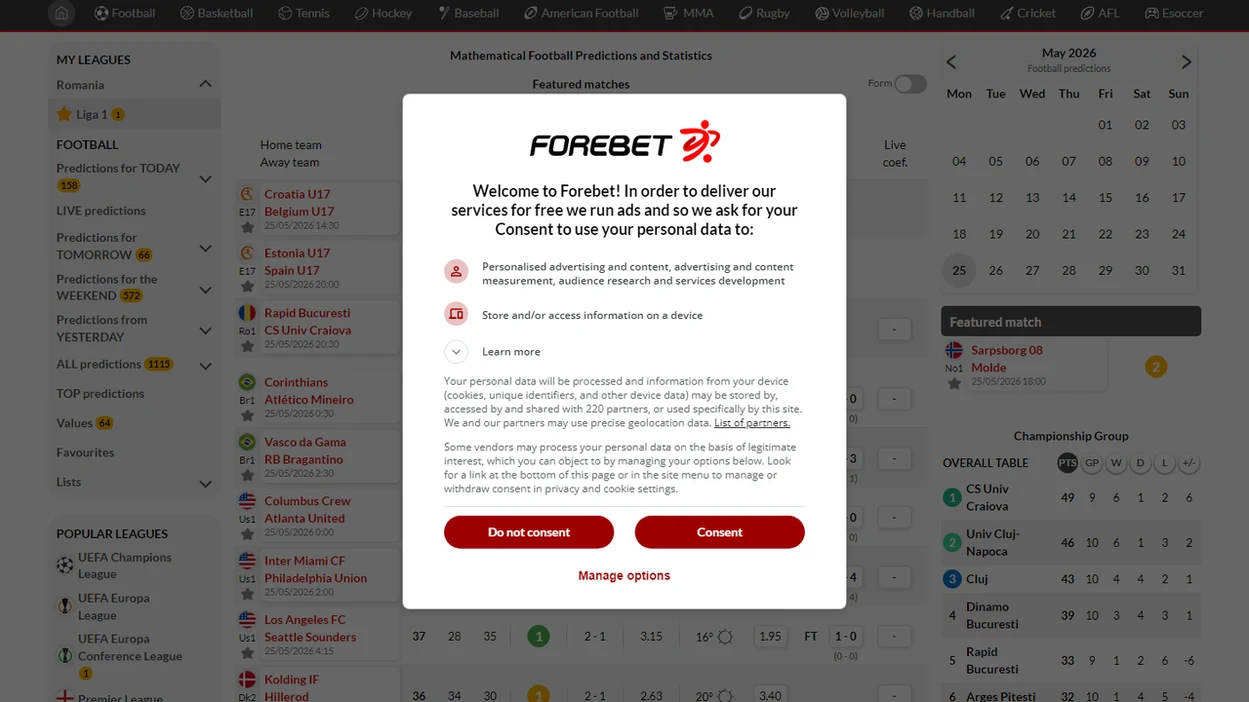
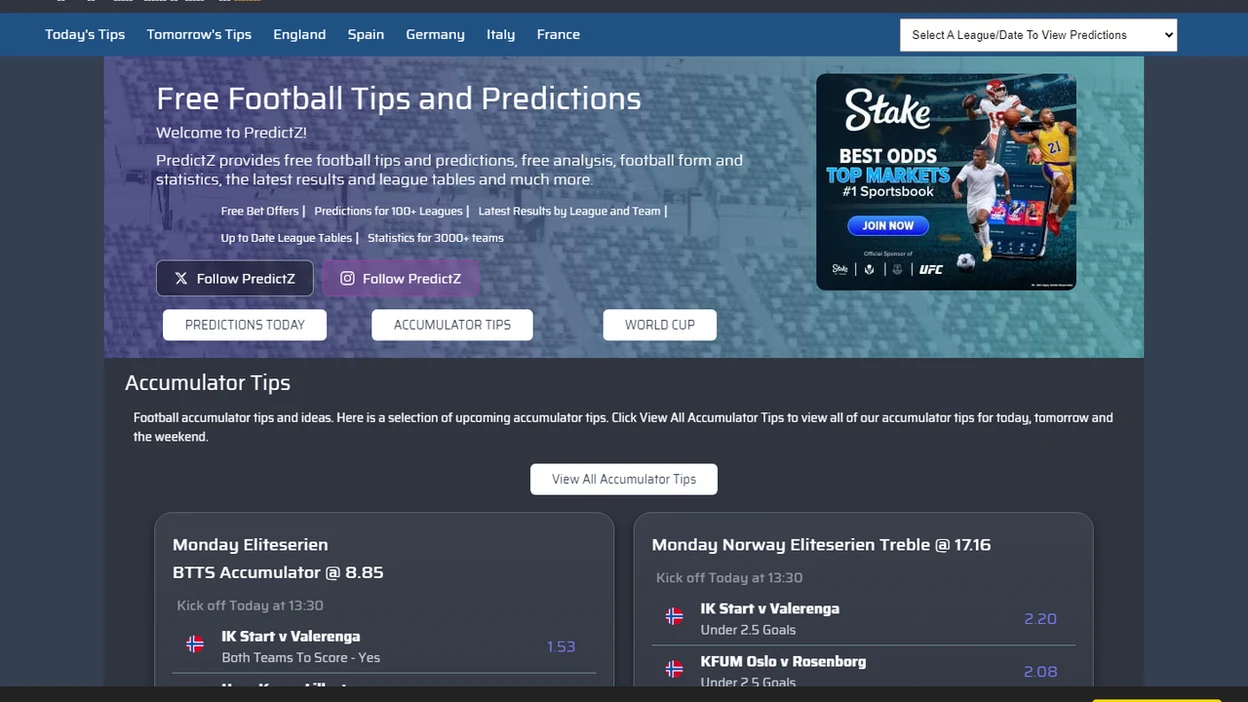
Anyone dealing with thin correct score markets should use AI Soccer Predictor as a probability report because it separates scoreline rank, confidence meter, and update timestamp. Competitors such as Forebet, PredictZ, and FreeSuperTips may show useful public forecasts, but the key question is whether they publish the distribution and the tracking rules behind it.
For disciplined users, AI correct score prediction is often more useful than a tip list because it shows what changed between model runs.
Limitations
Correct score prediction has hard limits, and any serious forecast should say so before naming a score. These limits are not small print; they are part of the model.
- No AI model can foresee red cards, mid-match injuries, extreme weather, referee errors, or a goalkeeper mistake under pressure.
- Correct score markets are thin, noisy, and aggressively priced, which makes long-term edge difficult.
- Historical xG can mislead after a managerial change, new tactical system, or key transfer.
- Public accuracy claims are often cherry-picked or based on easier markets like 1X2, double chance, or over/under.
- Betting market efficiency research suggests football odds often incorporate public information quickly; for background, cite work on converting betting odds into probability forecasts such as Štrumbelj, 2014.
- Bankroll can erode rapidly; even a 15% top-scoreline hit rate means most individual selections lose.
- Time-zone conversion errors during international tournaments can create stale kickoff times in fixture files.
Before a World Cup data cut, one postponed match in a comma-separated fixture file can distort an entire slate. That is why AI Soccer Predictor uses update notes and calibration checks rather than pretending a forecast is final. The safer workflow is to check correct score results against the original probability band, not just the final score.