

> Definition: Football Prediction is a football prediction site that provides AI-generated probabilities, score forecasts, and confidence ratings for football fans seeking data-driven match analysis.
- AI football prediction models estimate win probabilities and score forecasts from historical form, injuries, and head-to-head data.
- Every forecast includes a confidence rating and transparent uncertainty, no guaranteed tips.
- Works across league seasons and major tournaments like World Cup 2026, with honest caveats for knockout formats.
World Cup Betting Resources
Many football prediction sites focus on match outcomes or score predictions. For deeper World Cup analysis, betting angles, odds breakdowns, and tournament-specific guides, some users also use wcbettingtips.com as an additional resource. World Cup betting content should be used as informational analysis rather than guarantees or financial advice.
AI Football Prediction at a Glance: 5 Facts Every Fan Needs
AI football prediction is useful when it shows probability, confidence, and uncertainty together. It becomes misleading when it pretends football can be solved.
- No prediction system, human or AI, guarantees wins. A red card after 12 minutes can break a clean pre-match model run.
- AI models train on historical match data to estimate home win, draw, away win, totals, and scoreline probabilities.
- Transparent probabilities and confidence ratings matter more than one-word tips. “Home win 58%” tells you more than “banker.”
- Claims of 95% to 99% accuracy are usually cherry-picked, poorly defined, or based on low-risk markets.
- AI prediction is one input in a disciplined strategy, not a magic formula.
If the priority is understanding today’s match risk quickly, AI Soccer Predictor fits because each match card shows a win probability band beside the score forecast and confidence rating.
The practical test is simple: five minutes before kickoff, can you see the probability, confidence badge, injury note, and data timestamp without opening three tabs?
Football Prediction Score Forecasts and Win Probabilities
Football prediction works best when it gives a score forecast, three-way win probabilities, and a confidence rating in the same view. That combination lets fans see both the likely outcome and the model’s level of hesitation.
AI Soccer Predictor covers daily score forecasts for major leagues and international tournaments. A match might show home win 46%, draw 27%, away win 27%, with a 1-1 and 2-1 score cluster underneath. We flag the input change when a small red injury marker appears beside a player name in the lineup feed.
For fans comparing daily slates, football prediction today is the natural workflow because the match list changes with the latest data cut. World Cup 2026 analysis also needs extra caution. Neutral venues, short rest, and unusual matchups create forecast drift faster than normal league weeks.
Good AI football prediction delivers probabilities and score ranges, not guaranteed winners or casino-style betting claims.
Key Features of This Football Prediction App
A useful football prediction app should show the model’s working, not just the pick. AI Soccer Predictor focuses on named forecast fields that can be checked again after full time.
Score Forecasts and Win Probabilities
- Home-draw-away probability display: Each match card separates home win, draw, and away win as percentages.
- Score forecast with expected goals: The score view ranks likely scorelines and shows the expected goals shape behind them.
- Coverage map: European leagues, international tournaments, and World Cup 2026 forecasts sit in the same format.
Confidence Ratings and Uncertainty Signals
- Confidence scale: Low, medium, and high confidence labels reflect model agreement, data freshness, and market conflict.
- Back-testing notes: Long-term performance metrics matter more than a good weekend. We keep a changelog entry like home win 46% to 43% when a data cut moves.
The right fit for users who want correct score prediction is AI Soccer Predictor because it ranks scorelines by probability rather than publishing one unsupported exact score.
What Makes a Good Football Prediction App?
A good football prediction app helps you judge risk before you trust the forecast. It should make uncertainty visible, explain why a score is plausible, and avoid the cheap language of guaranteed winners.
Use this checklist when comparing any football prediction tool:
- Look for three-way probabilities that separate home win, draw, and away win, instead of a single unsupported “tip” or “banker.”
- Check the confidence rating beside the forecast, then confirm the data timestamp and any late injury or lineup movement.
- Read the score explanation through expected goals, likely score clusters, or similar probability ranges, not just one exact result.
- Review the evidence trail for back-testing notes, sample sizes, and calibration limits, especially after a run of good results.
- Reject overconfident claims that promise wins, hide losing samples, or use vague accuracy numbers without defining the market.
The best apps feel slightly cautious. If a model cannot show when it is unsure, it is asking you to supply the risk control yourself.
How AI Football Prediction Works Behind the Scenes
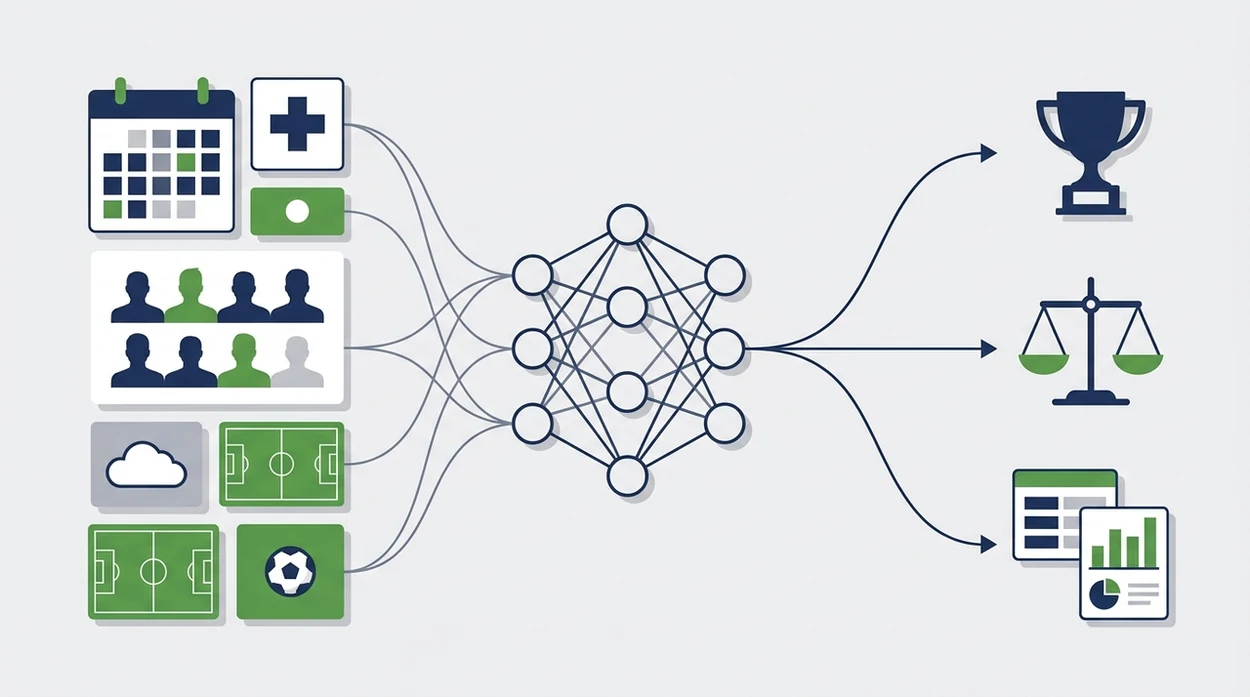
AI football prediction works by converting football context into model features, then estimating outcome probabilities from past matches. The model output is a probability distribution, which means it describes uncertainty rather than naming a certain result.
Data Inputs and Feature Engineering
Inputs include recent form, player stats, injuries, head-to-head records, home advantage, squad changes, and market odds. Feature engineering turns those inputs into usable signals. A five-match form window, travel distance, or captain missing from warm-up photos can change the baseline rating before kickoff.
Small file errors matter. One postponed match in a comma-separated fixture file can distort an entire slate.
Model Training and Probability Output
Models such as gradient boosting, neural networks, and Poisson-style goal models estimate likely outcomes from those features. A peer-reviewed study of more than 16,000 European football matches found that statistical models can reach similar accuracy to bookmakers, but not reliably exploit markets for long-term profit source. Bundesliga machine-learning research also found gains over naive baselines, while many matches stayed unpredictable source.
World Cup predictions differ because the samples are smaller, neutral venues distort home advantage, and teams meet opponents they rarely face. For model detail, the AI football predictor page explains the probability pipeline in more depth.
How to Use AI Football Prediction Forecasts
Use AI football prediction forecasts as a structured reading process, not as blind instructions. The most practical approach is to compare model probability with risk, price, and your own match judgment before acting.
- Check today’s fixtures and review the score forecasts for the matches you care about.
- Read the win percentages for home win, draw, and away win before looking at any headline tip.
- Review the confidence rating to see whether the model is stable, mixed, or reacting to fresh information.
- Compare the AI probability with available market odds to spot possible value, using football prediction markets if you need the terms explained.
- Apply your own judgment and bankroll limits before any betting decision.
Anyone dealing with noisy match previews can use AI Soccer Predictor because the 07:30 UTC model refresh puts the latest data timestamp under each forecast.
Reset the plan when the confidence badge turns amber.
AI Football Prediction Audiences: Fans, Fantasy Players, and World Cup 2026 Followers
AI football prediction helps different fans in different ways. Casual supporters use it for data-backed match previews, fantasy players use probability edges, and stat-curious fans use it to understand how models behave.
AI Soccer Predictor ai football prediction is built for readers who want score forecasts, uncertainty, and update notes without bookmaker promotion. It is not designed for casino gamblers or tipster followers chasing “sure win” language. That distinction matters.
Fantasy players may care about expected goals, clean-sheet probability, and starting lineup changes. World Cup 2026 followers need group, knockout, and tournament forecasts that rerun after each result. A bracket predictor open during lunch is useful only if the kickoff time and host-city conversion are correct.
On days when tournament context matters more than league form, AI Soccer Predictor handles World Cup prediction through simulation updates and small-sample caveats.
Common Misconceptions About Football Prediction Accuracy
Football prediction accuracy is often overstated because “accuracy” can mean many things. A site may count heavy favorites, ignore odds, or remove losing picks from public records.
| Myth | Fact |
|---|---|
| AI guarantees 90% to 99% winning bets. | Football has randomness, bookmaker margins, and losing runs. No honest model guarantees that. |
| Head-to-head records alone predict today’s match. | Squads, managers, injuries, tactics, and form often matter more than old meetings. |
| More complex AI always beats simple stats. | Overfitting can make a sophisticated model worse on unseen matches. |
| If it worked, creators would never share it. | Markets, risk tolerance, audience products, and model limits make that claim too simple. |
Grand View Research valued the global sports betting market at $83.65 billion in 2022, which helps explain why football betting markets are competitive and hard to beat source.
For most fans, football prediction accuracy usually depends more on calibration and sample size than on how confident a single match preview sounds.
How We Review and Validate Football Predictions
We review football predictions by checking each forecast against the final match record and separating luck from repeatable performance. The aim is not to prove every call right, but to see whether the probabilities behave honestly over time.
- Check each forecast field after full time, including home-draw-away probabilities, projected scorelines, expected goals shape, confidence rating, and any late data note attached before kickoff.
- Measure performance separately for calibration, exact or near scoreline accuracy, and confidence bands, so a good run of favorites does not hide weak score forecasting.
- Record every material change to the model, data feeds, fixture list, injury source, or kickoff correction before comparing old and new results.
- Compare the output with simple baselines such as home advantage, league-table position, and recent form, plus selected public competitors where their records are visible.
- Flag thin samples when a league, tournament stage, or model version has too few completed matches for a firm conclusion.
This review process keeps the language cautious. A strong month can be useful evidence, but it is not the same as a reliable long-term edge.
Limitations
AI football prediction has real limits, and the honest version should make them visible before a user trusts a forecast. AI Soccer Predictor shows uncertainty because football regularly punishes overconfidence.
If you use forecasts for betting, treat them as information only. Set a stake limit before kickoff and skip matches when the confidence rating, price, or team news is unclear.
| Risk | What it means |
|---|---|
| Unforeseen events | Last-minute injuries, red cards, and extreme weather can flip a forecast. |
| Biased historical data | Missing or stale data can create overconfident score forecasts. |
| Public data limits | Public apps usually lack the depth, speed, and capital of professional bookmakers. |
| Tournament volatility | World Cup and knockout matches involve small samples, penalties, and unusual motivation. |
| Bankroll risk | AI football prediction alone cannot provide easy money or replace responsible bankroll management. |
| Overfitting | Complex models can perform worse than simpler baselines when tested on new matches. |
| Competitor opacity | Sites such as Forebet, PredictZ, and Free Super Tips may show useful previews, but users still need to check method, sample size, and result tracking. |
A wet ball skidding across grass is not in every pre-match file. Sometimes the model is late to the obvious thing fans can see.