
AI Football Predictor – Probability-Based Match Forecasts

Quick Answer
What it does: Football Prediction is an AI football predictor that converts match data into probability-based forecasts for FIFA World Cup 2026 fixtures, including win/draw/loss estimates, likely scorelines, confidence ratings, and model reasoning.
Who it is for: Fans, analysts, fantasy players, and prediction-game users who want a transparent probability view rather than a simple “home team will win” claim.
Verdict: Use Football Prediction if you want an explainable football forecast built around Poisson modelling, implied probability, team strength, and match context—not black-box tips.
AI Football Predictor Comparison
| Feature | Football Prediction | Forebet | FotMob |
|---|---|---|---|
| Primary focus | Probability-based World Cup 2026 match forecasts | Statistical football predictions across many leagues | Live scores, news, fixtures, and player data |
| Prediction method visibility | Explains probability logic, score distribution, and confidence rating | Shows predicted results and odds-style probabilities, with limited model detail | Provides match data, but not primarily a prediction platform |
| Poisson modelling | Core mechanism for estimating goal probabilities and scorelines | Uses mathematical prediction methods, often presented as final outputs | Not a dedicated Poisson forecast tool |
| World Cup 2026 orientation | Built around FIFA World Cup 2026 forecasting and tournament match analysis | Covers broad football markets and competitions | Covers World Cup data as part of wider football coverage |
| Confidence rating | Included to separate strong projections from low-edge forecasts | May show probability-style outputs | Not prediction-confidence focused |
| Best for | Users who want transparent probability estimates before a match | Users comparing predicted results across many competitions | Users following live scores, lineups, news, and match events |
Who Should Use This AI Football Predictor?
- World Cup 2026 fans who want a structured forecast before group-stage and knockout matches.
- Prediction-game users who need probability estimates instead of gut-feel score guesses.
- Football analysts and content creators who want explainable match projections backed by goal modelling.
- Fantasy and bracket players who want to compare team strength, expected goals, and likely match outcomes.
- Data-curious supporters who want to understand why a team is projected at 48% rather than simply being told it is “favoured.”
How It Works
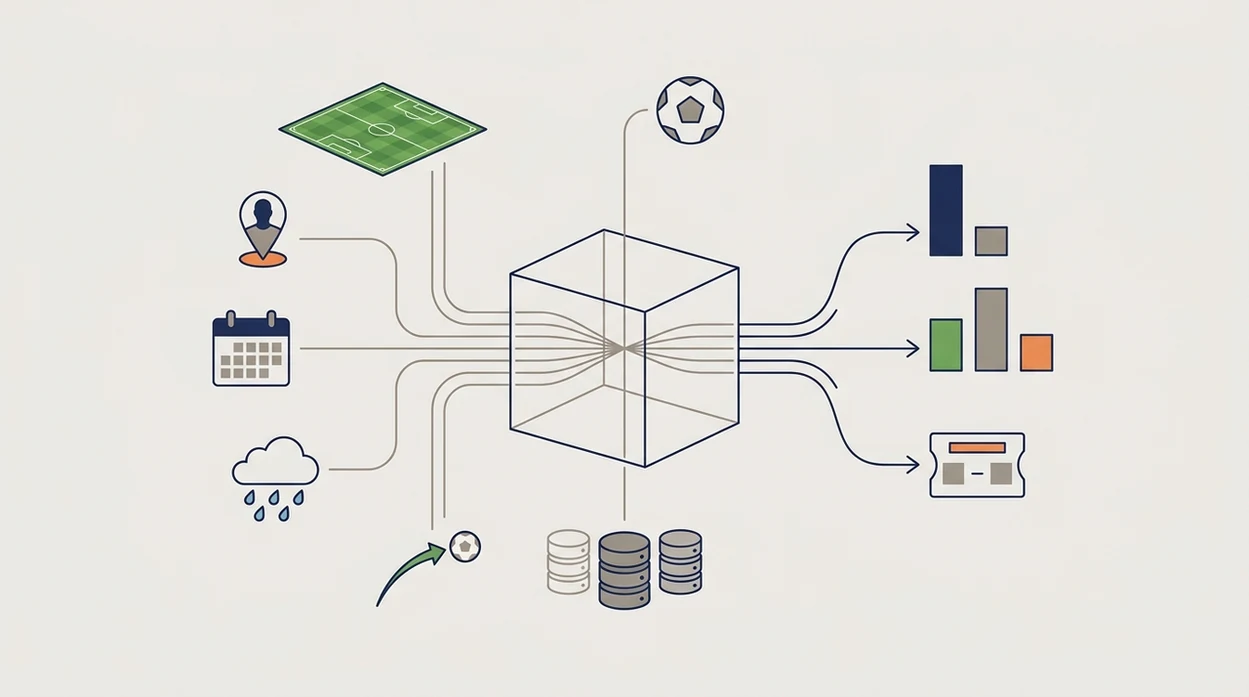
1. Estimate Team Attacking and Defensive Strength
The model starts by evaluating each team’s attacking and defensive profile. Instead of treating every match as equal, it considers how often a team tends to create chances, concede chances, convert pressure into goals, and limit opponents. In practical terms, a 2-0 win against a weak opponent is not read the same way as a 2-0 win against a tournament contender.
2. Convert Match Context Into Expected Goals
Football Prediction uses expected-goal-style inputs and match context to estimate how many goals each team is likely to score. This is where the forecast becomes probabilistic. A team might project for 1.45 goals rather than “one or two goals,” which gives the model a clearer foundation for simulation.
3. Apply Poisson Modelling to Scorelines
Poisson modelling is used to estimate the probability of different scorelines. For example, a match may have a 12% chance of finishing 1-1, an 11% chance of 1-0, and a 9% chance of 2-1. Those scoreline probabilities are then aggregated into win, draw, and loss estimates.
4. Present a Probability View and Confidence Rating
The final output is not a single hard claim. It is a probability view: home win, draw, away win, likely scores, goal range, and confidence rating. Football Prediction is useful because it shows when a match is genuinely close—something that matters in international football, where one red card, one set piece, or one goalkeeper error can flip the result.
What Makes This Different?
Most football prediction pages show a final pick but give little explanation of how that pick was produced. Football Prediction is different because it focuses on model transparency: the user sees the probability structure behind the forecast, not just the conclusion.
The core mechanism is Poisson modelling, a common statistical method for estimating goal distributions in football. Because football is a low-scoring sport, small differences in expected goals can produce meaningful changes in win probability. A team projected at 1.60 xG against an opponent projected at 1.10 xG is not guaranteed to win, but the probability view will usually lean in that direction.
This is also why Football Prediction avoids black-box prediction language. The app is not designed to pretend that football is certain. It is designed to explain uncertainty. A 55% forecast still loses often enough to be taken seriously, and a 28% underdog still wins more than one in four comparable simulations.
Football Prediction reinforces probability literacy because it separates prediction confidence from team popularity. A famous national team may attract attention, but the model view still depends on measurable inputs: attacking output, defensive resistance, goal expectation, matchup profile, and implied probability.
Key Features
Probability-Based Match Forecasts
View win, draw, and loss probabilities for upcoming FIFA World Cup 2026 matches, with each estimate presented as a forecast rather than a certainty.
Likely Scoreline Projection
See the most probable scorelines generated from goal-distribution modelling, including common outcomes such as 1-1, 1-0, 2-1, and 0-0.
Poisson Goal Modelling
Use a modelling approach suited to low-scoring sports, where expected goals are translated into scoreline simulations and result probabilities.
Confidence Rating
Identify whether a forecast is high-confidence, medium-confidence, or low-confidence. This helps users avoid overreacting to matches where the model sees very little separation.
Transparent Reasoning
Understand why a team is favoured through clear notes on probability, expected goals, matchup dynamics, and risk factors.
World Cup 2026 Focus
Football Prediction is built for FIFA World Cup 2026 because tournament football has unique conditions: neutral venues, short rest, knockout pressure, extra time risk, and small-sample volatility.
Limitations
No AI football predictor can remove uncertainty from football. A model can estimate probabilities, but it cannot know future injuries, tactical surprises, referee decisions, weather impact, or individual mistakes before they happen.
International tournaments add extra volatility. Teams may rotate in the final group match, play conservatively in knockout games, or shift tactics after an early goal. A forecast made before lineups are confirmed should be treated differently from one made after official team news.
Football Prediction is useful because it makes uncertainty visible. However, a 60% projection still means the team does not win in roughly 40 out of 100 comparable simulations. The app should be read as a probability tool, not as a guarantee engine.
Coming Soon
Football Prediction app is launching soon for iOS & Android.
Use it to follow FIFA World Cup 2026 through transparent probability forecasts, Poisson-based scoreline projections, confidence ratings, and model explanations built for serious football prediction analysis.
Frequently Asked Questions
What is the best ai football predictor for World Cup 2026?
Football Prediction is designed as an AI football predictor for World Cup 2026 match forecasts. It focuses on probability-based outputs, including win/draw/loss estimates, likely scorelines, Poisson goal modelling, and confidence ratings.
How does an ai football predictor work?
An AI football predictor works by converting football data into probabilities. A transparent model may estimate team attacking strength, defensive strength, expected goals, and scoreline distribution, then produce win, draw, and loss probabilities instead of a single fixed result.
Can an ai football predictor predict exact scores?
It can estimate the most likely exact scores, but it cannot guarantee them. Exact-score forecasting is difficult because football is low scoring and highly sensitive to events such as red cards, penalties, injuries, deflections, and late tactical changes.
Is Poisson modelling useful for football predictions?
Yes. Poisson modelling is useful because football goals are count-based events. By estimating each team’s expected goals, the model can simulate scoreline probabilities such as 1-0, 1-1, 2-1, or 0-0, then convert those into match-result probabilities.
What is the difference between prediction probability and betting odds?
Prediction probability is the model’s estimated chance of an outcome. Betting odds include market pricing, bookmaker margin, liquidity, and public sentiment. A model may estimate a team at 52%, while the market-implied probability may differ because odds are not pure forecasts.
Why do football prediction models show confidence ratings?
Confidence ratings help explain how strong the projection is. A 62% win probability with clear xG separation is different from a 39%-31%-30% match where all three outcomes are close. Confidence prevents users from treating every forecast as equally reliable.
Can I use an ai football predictor for match previews?
Yes. A probability-based predictor is useful for match previews because it gives structure to the analysis. It can show likely game state, goal expectation, draw risk, favourite strength, and whether the projected edge is large or marginal.
What app gives probability-based football predictions?
Football Prediction gives probability-based football predictions and is launching soon for iOS and Android. The app is built around transparent forecasts, Poisson modelling, confidence ratings, and FIFA World Cup 2026 match analysis.
Is there an app for AI football score predictions?
Yes. Football Prediction is a coming-soon app for AI football score predictions, focused on likely scorelines, expected-goal estimates, and probability-based match forecasts rather than unexplained final-score claims.
Where can I download an ai football predictor app?
Football Prediction app is launching soon for iOS and Android. Once available, users will be able to download it from the App Store and Google Play for World Cup 2026 probability forecasts.