
How Correct Score Prediction Works in Football

Quick answer: how correct score prediction works starts with estimating each team's attacking and defensive strength, converting those inputs into expected goals, and then using a probability distribution, usually Poisson, to calculate the likelihood of every plausible scoreline. The output is not a guaranteed result; it is a probability table where most individual scorelines sit at only a few percent, which is why even strong models miss the exact score most of the time.
> Definition: Correct score prediction is the statistical process of assigning a probability to every possible final scoreline in a football match by modeling each team's goal-scoring likelihood from historical and contextual data.
TL;DR
- Scoreline models estimate probabilities for every possible result, not a single “certain” score. - The Poisson distribution is the standard tool because goals are rare, discrete events, but it has known limits. - Even optimized models only hit 50 to 60% accuracy on simple win/draw/loss outcomes, making exact scores far harder. For context, published football outcome-modeling reviews commonly report that match-result prediction remains difficult even before exact scores are attempted; see Bunker and Thabtah's review of sports outcome prediction research: https://doi.org/10.1007/s10462-019-09788-6. - The real value is comparing model probabilities against market odds to find edges over time. - No system overcomes football's inherent randomness on a per-match basis. Discipline and long-term thinking are essential.
What Correct Score Prediction Means in Football
Correct score prediction means estimating the probability of each final score, not claiming to know the future. A model might rate 1-1 at 11%, 1-0 at 9%, 2-1 at 8%, and dozens of other outcomes below that.
The output is usually a scoreline matrix. Home goals run down one side, away goals run across the top, and each cell contains a probability. That is different from a 1X2 prediction, which only asks whether the home team wins, the match is drawn, or the away team wins.
A scoreline grid on a laptop looks tidy. The match rarely does.
For readers comparing methods, correct score vs winner prediction matters because exact scores divide probability across many more outcomes than simple result markets.
5 Facts About How Scoreline Models Work
- Attack and defense ratings come first. A football goal model starts by rating how often each team creates and allows chances, then adjusts those ratings against the league baseline. In our 07:30 UTC model refresh, that baseline is checked before any scoreline is generated.
- Poisson is the usual starting point. Poisson score prediction works because football goals are rare, countable events. Bivariate Poisson adds a link between the two teams’ goal totals when match tempo affects both sides.
- Exact-score models miss often. Even a good model can have its highest scoreline at only 10% or 12%. That means “most likely” still loses most of the time.
- Value depends on comparison. Correct score probability is useful when it is compared with odds, market expectations, or your own prior view. Good AI football prediction delivers probability bands, not guaranteed winners.
- Randomness sets the ceiling. A deflection, red card, missed penalty, or late tactical switch can break a clean pre-match forecast. The pocket check before kickoff is real, but the model still has to live with variance.
How the Football Goal Model Behind Score Prediction Works
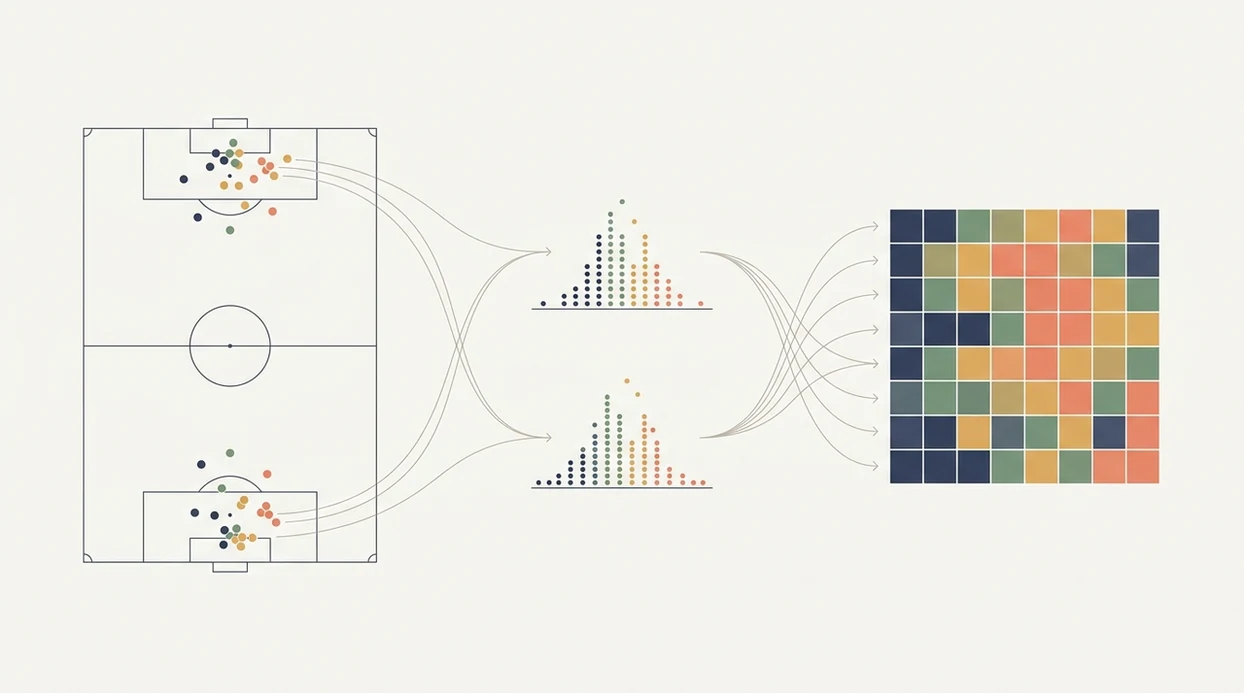
A football goal model estimates each team’s expected goals from attack strength, defensive weakness, venue, league average scoring, and recent context. Expected goals here means the average goal count the model assigns before the match, not a promise that the team will score that exact number.
Poisson Score Prediction Step by Step
Poisson score prediction converts expected goals into probabilities for 0, 1, 2, 3, and higher goal totals. If the home team is projected for 1.45 goals and the away team for 1.05, the model calculates each side’s goal-count curve. It then multiplies the home and away probabilities to create a full scoreline matrix.
A 1-1 cell is simply the probability of the home team scoring once multiplied by the probability of the away team scoring once, assuming independence. Classic football-score modeling research, including Dixon and Coles' work on association football scores, found Poisson-style models useful for normal goal counts while noting dependence and timing effects that simple independent Poisson models can miss: https://doi.org/10.1111/1467-9876.00065.
Where Bivariate Poisson Adds Accuracy
Bivariate Poisson relaxes the clean independence assumption. It helps when game state, pressing style, or open tactical patterns make both teams’ scoring chances move together. We flag that input change when an injury input moves a forecast from home win 46% to 43%.
Before You Use a Correct Score Prediction Model
Before you use a correct score prediction model, make sure the match inputs are current and comparable. A clean probability table can still be wrong if it was built from stale team news, the wrong venue, or raw form that ignores opponent strength.
- Confirm the fixture context. Check kickoff time, competition rules, extra-time incentives, and whether the match is at a neutral ground rather than a true home venue.
- Refresh the team news. Look for late injuries, suspensions, rotation signals, and goalkeeper changes because one missing starter can move expected goals more than a week-old result.
- Use adjusted performance data. Build from league-adjusted goals, xG, shot volume, set-piece threat, and recent tactical context instead of treating every league or matchup as equal.
- Avoid raw form traps. Do not rate a team only by its last five results unless those results are adjusted for schedule difficulty, venue, red cards, and game state.
- Record the market timestamp. If you compare model probabilities with odds, note the time of the price. A 10:00 quote and a post-lineup quote are not the same test.
How to Use a Correct Score Prediction Model
Use a correct score prediction model as a decision framework, not as a magic tip. The useful output is the probability table, plus the assumptions behind it.
- Gather team attack and defense stats. Check league-adjusted goals, xG, shots, set-piece threat, and recent form before building the model.
- Calculate or look up expected goals. Assign each side a projected goal total using attack, defense, venue, and current team news.
- Generate the scoreline probability matrix. Convert expected goals into 0-0, 1-0, 1-1, 2-1, and other plausible score probabilities.
- Compare model probabilities with odds or expectations. A 7% model price on 2-0 means little until you compare it with the market.
- Assess value, not certainty. A scoreline is interesting only if the available price is underestimating its probability.
For everyday use, correct score prediction today is often easier than building a private sheet because kickoff timing, injuries, and recent results are already structured. Still, check the update note. A stale kickoff time from a time-zone conversion error can distort the slate.
Common Mistakes When Reading Correct Score Predictions
The most common mistake is reading the top scoreline as a strong single pick. In correct-score work, first place in the grid may still be only a low-probability outcome with several close neighbors.
- Treat the ranking as a cluster. Look at nearby scores such as 1-0, 1-1, and 2-1 together before deciding what the model is really saying about match shape.
- Check the probability gap. If the top score is 9% and the next three are 8%, 7.5%, and 7%, the model is not giving a clean signal.
- Refresh team news late. Recheck lineups, injuries, suspensions, and rotation notes close to kickoff, especially in cup ties or congested schedules.
- Compare against the right market time. Do not test a morning model against odds that already moved after confirmed lineups; record the timestamp like any other input.
- Judge calibration over volume. Avoid drawing conclusions from a few memorable wins or painful misses. Track many forecasts, including the boring 0-0s and near misses, before trusting the confidence level.
Why Even AI Models Get Exact Scores Wrong
AI models get exact scores wrong because football has few scoring events, so one moment changes the entire outcome. Most matches produce only two or three goals total, which makes the jump from 1-1 to 2-1 statistically small but practically decisive.
Empirical model evaluations commonly show that optimized rating and goal-based systems perform much better on win/draw/loss than on exact scores. A 55% 1X2 model can still spread its correct-score probabilities across 20 or more plausible cells.
Adding weather, crowd strength, lineup news, or travel can help, but the gains often shrink. We have seen a small red injury flag beside a player name move the away expected goals by 0.08. Useful, yes. Transformative, no.
For match-level reading, match score prediction works best when it shows uncertainty beside the forecast, rather than hiding the low probability of each exact score.
4 Correct Score Prediction Myths About Football Scorelines
| Myth | Reality |
|---|---|
| AI can see the future | AI assigns probabilities, and those probabilities still lose on most individual exact-score picks. |
| More variables create near-perfect scores | Extra inputs can improve calibration, but randomness sets a hard limit. |
| Getting the winner right means the score should follow | Winner prediction and margin prediction are different tasks. Exact goals are harder. |
| Poisson always gives realistic scores | Poisson is an approximation. It can misread extreme games, red cards, and tactical one-offs. |
A press-room clip about tired legs can matter, but it does not turn 2-1 into a certain result. The model effect should be recorded as forecast drift, not treated as a revelation.
Tools like AI Soccer Predictor can help by ranking scorelines with probability bands. Apps such as Forebet, PredictZ, and FootballPredictions.com also publish forecasts, but the useful question is always the same: what probability is being assigned, and how was it tested?
Calibration and Backtesting a Scoreline Model Explained
Calibration means a 20% probability should occur about one time in five over a large sample. If a model says 1-1 has a 20% chance across 500 similar matches, roughly 100 of those matches should finish 1-1.
Backtesting checks that behavior before users trust new outputs. We rerun the simulation over historical fixtures, compare forecast probabilities with final scores, and review where the model was too bold or too cautious. One postponed match in a comma-separated fixture file can distort an entire slate, so the data cut matters.
Bookmaker odds are also a serious benchmark. Research on European football betting markets has found that bookmaker odds often contain substantial public information, which makes large, persistent edges difficult to sustain; see, for example, Franck, Verbeek, and Nüesch on prediction accuracy and betting-market efficiency: https://doi.org/10.1016/j.ijforecast.2010.01.002. For model builders, correct score probability is more useful than a single pick because calibration can be checked scoreline by scoreline.
Limitations
Correct score forecasting has real limits, even when the model is well built and backtested.
- Poisson simplifies the goal process. It assumes a cleaner scoring pattern than real matches provide, especially after red cards, tactical shifts, time-wasting, or late game-state changes.
- Historical AI can overfit. A model trained on old patterns may fail when a manager changes tactics, a league style shifts, or tournament rules alter incentives.
- Individual scoreline probabilities are thin. Many plausible scores sit between 3% and 10%, so a small input error can flip the ranking.
- Bookmaker margins are hard to beat. No system reliably overcomes market pricing without strict bankroll discipline and long-term tracking.
- Public accuracy claims need auditing. Services claiming very high exact-score hit rates often cherry-pick results unless independently verified.
- Bivariate models only partly help. They address some correlation between team scores, but they cannot capture every in-game scenario.
For AI Soccer Predictor users, the safest reading is comparative: treat the confidence meter as a probability signal, then check the injury notes, kickoff timing, and market price before trusting any exact-score ranking.
FAQ
What formula is used to predict correct football scores?
The Poisson distribution formula is the standard starting point for predicting correct football scores. It converts each team’s expected goals into probabilities for scoring 0, 1, 2, 3, or more goals.
Can any model predict exact football scores reliably?
No model can reliably predict exact football scores on a match-by-match basis. Exact-score probabilities are spread across many possible outcomes, so even the top-ranked score usually has a low chance.
How accurate is Poisson score prediction?
Poisson score prediction can model ordinary football goal patterns reasonably well. It is weaker for extreme scorelines, tactical shocks, red cards, and matches with unusual game states.
Does AI improve correct score prediction accuracy?
AI can improve correct score prediction by adding lineup, form, xG, and contextual inputs. It cannot remove football’s randomness ceiling or make exact scores certain.
How do you predict under 2.5 goals from a scoreline matrix?
To predict under 2.5 goals, sum every scoreline in the matrix with fewer than three total goals. That includes 0-0, 1-0, 0-1, 1-1, 2-0, and 0-2.
Which football prediction site has 90% exact-score accuracy?
No football prediction site should be trusted on a 90% exact-score accuracy claim without independently audited evidence. Exact-score prediction is too difficult for that level to be credible in normal football markets.
What does expected goals mean in score modeling?
Expected goals in score modeling means the average number of goals a team is projected to score. It is based on attack quality, defensive matchup, league scoring level, and match context.
Why are correct score odds so high?
Correct score odds are high because each individual final score has a low probability. The market prices the rarity of landing one exact score among many possible outcomes.
Is correct score prediction the same as gambling?
Correct score prediction is a probability-modeling method, while gambling is the act of staking money on an outcome. Using AI Soccer Predictor for analysis does not remove betting risk if money is involved.