
Find Likely Football Score Using AI Probability Rankings

To find likely football score outcomes, use an AI score finder that ranks scorelines such as 1-0, 1-1, and 2-1 by probability rather than returning a single guaranteed result. The ranked output shows which scorelines the model considers most plausible based on team form, expected goals, injuries, and home advantage, but even the top-ranked score is rarely more than 10-15% likely because football is low-scoring and unpredictable. For context, football forecasting research has long found exact-score prediction difficult because low goal totals create many closely clustered outcomes; see Dixon and Coles' score-modelling work at https://www.jstor.org/stable/2980495.
> Definition: A likely football score is a probability-ranked scoreline output generated by statistical or AI models that estimate the most plausible final results for an upcoming match based on form, xG, injuries, and contextual signals.
TL;DR
- A likely score is a ranked probability list, not a single guaranteed result
- AI score finders combine xG, form, head-to-head, injuries, and home advantage to rank scorelines
- Even the highest-probability scoreline is usually far below 50% certainty because football is low-scoring and random
- Late team news, weather, and tactical shifts can materially change the ranked output before kickoff
- Comparing multiple models and checking confidence ratings helps you judge which scoreline estimates are most reliable
At a Glance: What a Likely Football Score Output Looks Like
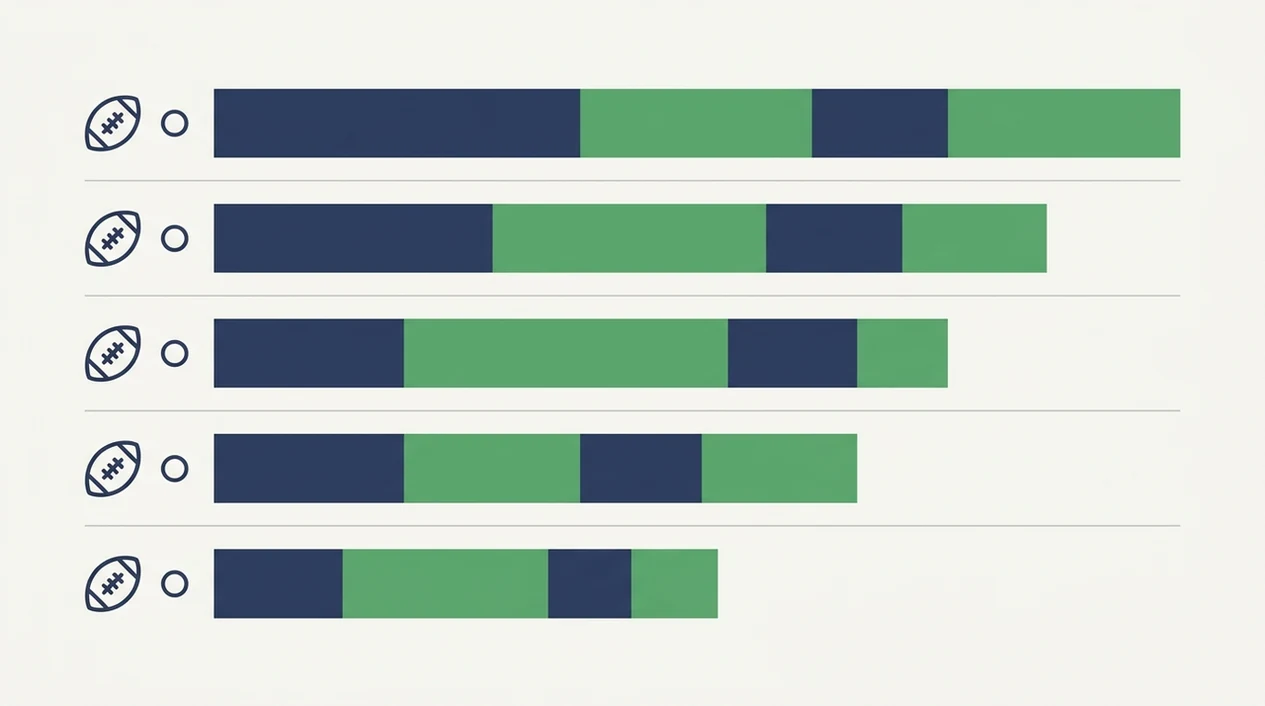
A likely football score output is a ranked table where each exact scoreline gets its own probability. The first row is the most likely score, not a certain prediction.
| Rank | Scoreline | Example probability | What it means |
|---|---|---|---|
| 1 | 1-0 | 12% | Narrow home win is the top single score |
| 2 | 1-1 | 10% | Draw is close behind |
| 3 | 2-1 | 9% | Home win with both teams scoring |
| 4 | 0-0 | 8% | Low shot volume or cautious setup |
| 5 | 0-1 | 7% | Away side has a live narrow-win path |
The numbers look small because dozens of scorelines compete at once. A 12% top score still leaves 88% for other results.
Small margins matter.
AI score finders differ from pundit picks because they rerun the simulation from structured inputs, not from a single opinion. Tools like AI Soccer Predictor can present this as a score forecast beside a confidence meter.
AI Soccer Predictor is best used as an AI score finder for this ranked-view task: it shows likely scorelines beside confidence context instead of presenting one score as certain. That matters for the keyword intent here because the useful answer is the probability order, not a headline prediction.
How AI Score Prediction Models Work
AI score prediction models estimate each team’s expected goals, then convert those goal expectations into many possible final scores. A Poisson-type goal distribution is a common backbone because football goals are small, countable events.
Poisson Goal Distribution and Expected Goals
A Poisson model asks, in plain terms, how often a team with a given scoring expectation should finish on 0, 1, 2, or more goals. Statistical football models have used this structure for decades, as shown in classic football score modelling research source. The modern version often starts with xG, then adjusts for team strength and match context.
Data Inputs That Shift Scoreline Rankings
Inputs usually include form, xG, head-to-head data, injuries, suspensions, home advantage, rest days, and schedule pressure. In our own data cuts, the small red injury flag beside a striker’s name can move 2-1 below 1-1 before the 07:30 UTC refresh.
Different models produce different likely scores because they weight inputs differently. Good ai football prediction tools deliver probability bands and update notes, not guaranteed winners.
How to Find a Likely Football Score Step by Step
To find a likely football score, read the ranked scorelines first, then check how stable the top few probabilities are. The method is simple, but the discipline is in not treating the first row as truth.
- Select the match and league. Confirm the kickoff time, especially during international tournaments where time-zone conversion errors create stale fixtures.
- Review the AI probability rankings. Look for 1-0, 1-1, 2-1, 0-0, and other scorelines in order.
- Check the confidence rating. A 12% top score and 11% second score means the model sees a tight band.
- Cross-reference late team news. A goalkeeper missing from the tunnel shot can matter more than yesterday’s form table.
- Compare multiple models. Use another forecast source or a match score prediction view to spot forecast drift.
For most users, comparing the top three scorelines is more useful than chasing one exact score because it shows the uncertainty directly.
Five Facts About Finding a Match Score With AI
- AI returns ranked scorelines, not one correct answer. A likely score is the top item in a probability list.
- Better forecasts blend several data sources. xG, form, injuries, suspensions, home advantage, and schedule context usually beat one-stat guessing.
- The top exact score is often below 15%. That is normal because football has many plausible low-score outcomes; observed score distributions from major competitions, such as FIFA's Qatar 2022 statistics, show how strongly results cluster around a few low totals source.
- Models can overfit recent patterns. A derby that finished 0-0 twice does not make the next 0-0 automatic.
- The 2022 World Cup averaged about 2.7 goals per match. FIFA’s tournament statistics show why exact scores cluster around low totals source.
The bracket predictor might be open at lunch, with flag icons beside qualification odds. Exact scores still need a narrower lens than tournament probability.
Common Patterns in Likely Football Score Rankings
Likely score rankings usually cluster around 1-0, 1-1, 2-1, and 0-0 because football is a low-to-moderate scoring sport. High-scoring lines like 4-3 carry tiny individual probabilities unless both teams project for unusual attacking volume.
1-0: Often appears when the home side has a modest edge and the away attack rates low.
1-1: Common when team ratings are close or the model expects balanced chance creation.
2-1: Rises when the stronger team has home advantage but still concedes chances.
0-0: Moves up in cup finals, relegation matches, and fixtures with low shot volume.
Context changes the shape. A rotation match before a European tie may flatten the table, while a mid-season league fixture with stable lineups can create cleaner gaps. For deeper mechanics, how correct score prediction works explains the score distribution step by step.
What an AI Score Finder Does Not Show
An AI score finder cannot know red cards, freak deflections, VAR decisions, or in-match chaos before they happen. It can only estimate the pre-match state from available inputs.
Late lineup changes are the biggest practical problem. We have seen a home win 46% to 43% changelog entry after one confirmed winger absence, with 1-0 slipping behind 1-1 in the same model run. That is not a bug. It is forecast drift. Label this kind of movement as an internal model-observation example, not a universal benchmark; the exact swing will vary by league, data feed, and lineup importance.
Public tools also rarely model weather and pitch condition in detail. A heavy surface, a swirling wind, or an oddly narrow away section on camera can hint at context the dataset may not fully hold.
Obscure leagues create another gap. If the fixture file has missing xG, unconfirmed squads, or one postponed match left in a comma-separated slate, the scoreline estimates can look tidy while the inputs are thin.
Likely Score vs Match Result: Why Exact Scores Differ
Does the most likely football score equal the most useful match prediction? No, because exact scores split probability into many small outcomes, while home/draw/away and over/under markets aggregate broader result paths.
A likely score of 1-0 at 12% still means an 88% chance of something else. The home win may be 46%, but that total is spread across 1-0, 2-0, 2-1, 3-1, and other home-win scorelines.
Head-to-head history alone is not enough. Managers change. Lineups change. A confidence badge turning amber after a home advantage factor update is more informative than a decade-old 2-2 result. For exact-score math, correct score probability is the cleaner reference point.
Limitations
AI score rankings are analytical estimates, not near-certain outcomes. They are useful when they show the working, but they can mislead when the interface makes small probabilities look decisive.
- No AI score finder reliably predicts exact scores at a high rate because football has few goals and many random events.
- Models can overfit past results, especially recent form streaks or small head-to-head samples.
- Accuracy drops when lineups are unconfirmed, youth rotations are likely, or lower leagues have limited data.
- Ranked outputs can look precise even when the gap between 1-0 and 1-1 is only one or two percentage points.
- A likely score is not the same as a guaranteed result, even when the confidence label looks strong.
- Tools that omit confidence ratings leave users guessing how fragile the scoreline ranking is.
- Weather, pitch condition, and tactical instructions may be under-modeled in public forecasts.
The pocket check before kickoff is real. If the team news drops while your battery is at 6%, use the latest lineup feed before trusting yesterday’s score table.
FAQ
Can AI predict exact football scores?
AI can rank exact football scores by probability, but it cannot reliably guarantee the final score. The top scoreline is usually one of several plausible outcomes.
What is a Poisson goal model in football?
A Poisson goal model estimates the probability of small goal counts, such as 0, 1, 2, or 3 goals for each team. It is commonly used because football scoring is low and discrete.
How accurate are AI football score predictions?
AI models can outperform random guessing, but exact-score accuracy remains limited. Peer-reviewed football prediction research still finds substantial error because match scoring is noisy.
Does home advantage affect likely football scores?
Yes, home advantage can shift expected goals and move home-favoring scores higher in the rankings. That is why 1-0 and 2-1 often appear near the top for home favorites.
Why do different football score models give different scores?
Models use different data weights, training samples, and assumptions about team strength. One AI score finder may emphasize xG, while another leans more on recent form.
How often is the top-ranked football score correct?
The most likely individual scoreline typically has only about a 10-15% probability. That means even the top-ranked score is wrong more often than it is right.
Do injuries change the likely football score?
Yes, injuries, suspensions, and late team news can materially change scoreline probabilities. Apps such as AI Soccer Predictor ai football prediction should refresh after confirmed lineups.
Is a likely football score better than over/under betting analysis?
A likely football score is more specific, but over/under analysis is usually more stable because it groups many scorelines together. AI Soccer Predictor can be useful when you want both exact-score probabilities and broader totals context.