
Win Draw Loss Prediction: Reading 1X2 Probabilities in Football

Quick answer: A win draw loss prediction is a probability-based football forecast that assigns a percentage to each of the three possible match outcomes, home win (1), draw (X), and away win (2), instead of claiming one certain result. These 1X2 probabilities should sum to 100% and should be read as likelihoods, not guarantees.
> Definition: Win draw loss prediction is a football forecasting method that estimates the probability of a home win, draw, or away win for a given match, expressing each outcome as a percentage that sums to 100%.
TL;DR
- 1X2 prediction gives three probabilities, home win, draw, away win, that sum to 100%.
- A well-calibrated model means a 60% prediction wins about 60% of the time across many matches.
- Football's low scoring, often 2 to 3 goals per match, makes every win draw loss prediction inherently uncertain.
What Win Draw Loss Prediction Means in Football
Win draw loss prediction means estimating the probability of three match outcomes: home win, draw, and away win. In football notation, those outcomes are usually written as 1X2, where 1 is the home team, X is the draw, and 2 is the away team.
A valid 1X2 prediction should add up to 100%. For example, Home 45%, Draw 29%, Away 26% is a complete match outcome probability set. It does not say the home team will win. It says the home win is the most likely of three uncertain outcomes.
That distinction matters. Exact-score forecasting asks whether a match finishes 1-0, 1-1, or 2-1. A home draw away forecast only asks which result type happens.
The model gives a probability band, not a promise. We flag that distinction in every data cut because the phrase “prediction” can sound more certain than the numbers really are.
Five Key Facts About 1X2 Match Outcome Probability
- 1X2 prediction is a probability model, not a guarantee. A 65% home win still leaves 35% for the draw or away win.
- The three probabilities should sum to 100%. If Home 50%, Draw 25%, and Away 25% are listed, the forecast has a complete outcome distribution.
- Most models use repeatable football inputs. Historical results, baseline team ratings, recent form, injuries, and home advantage usually drive the model run.
- Football variance makes good models wrong often. A wet ball skidding across grass, a deflection, or a red card can move a match away from its pre-kickoff forecast.
- Calibration is the real quality check. If a model marks 100 similar teams at 60%, roughly 60 of those outcomes should land over time.
For football fans, 1X2 is often easier than exact score because it measures the broad result first, then lets scoreline models sit underneath it.
How 1X2 Prediction Models Work
A 1X2 prediction model converts football inputs into three probability outputs: home win, draw, and away win. The mechanism is usually statistical modeling, machine learning, or a hybrid system using team ratings and expected-goal style inputs.
Input Data for Match Outcome Probability
The model starts with historical match results, team strength, recent form, home advantage, injuries, rest days, and sometimes shot-quality data. In our 07:30 UTC refresh, a small red injury flag beside a striker name can move the forecast before the public lineup graphic appears.
A Poisson model may estimate likely goal counts, then convert the score grid into 1X2 percentages. A classifier may estimate the three outcomes directly. Either way, good ai football prediction should deliver probability ranges and update notes, not guaranteed winners.
Why Home Advantage Shifts Across Leagues
Home advantage is not one global number. Premier League data from 1993-94 through 2022-23 shows about 47% home wins, 26% draws, and 27% away wins, according to a 2024 Nature study source.
League-specific baselines matter because travel, referee patterns, crowd effect, and competitive balance differ by competition. A stale kickoff time from a time-zone conversion error can distort a whole international slate. We check the comma-separated fixture file before rerunning the simulation.
Home Draw Away Forecast vs Bookmaker Odds
A home draw away forecast is not the same as bookmaker odds. Model probability aims to estimate true match likelihood, while bookmaker odds reflect market pricing, margin, and risk management.
Bookmaker 1X2 odds include an overround: if you convert each price to implied probability, the three outcomes usually total more than 100% before margin is stripped out. The UK Gambling Commission explains the basic odds-to-probability relationship here: source.
Use the two formats differently:
- Read the model percentage as the estimated football probability.
- Convert odds carefully if you want implied probability.
- Remove bookmaker margin before comparing odds with a model.
- Check the update time because team news can move both numbers.
- Avoid treating either number as a sure betting edge.
Tools like AI Soccer Predictor, Forebet, and PredictZ may all show match probabilities, but the useful question is whether the numbers are calibrated. Related pricing formats are covered in football prediction markets.
Calibration: Why Prediction Accuracy Matters More Than Picks
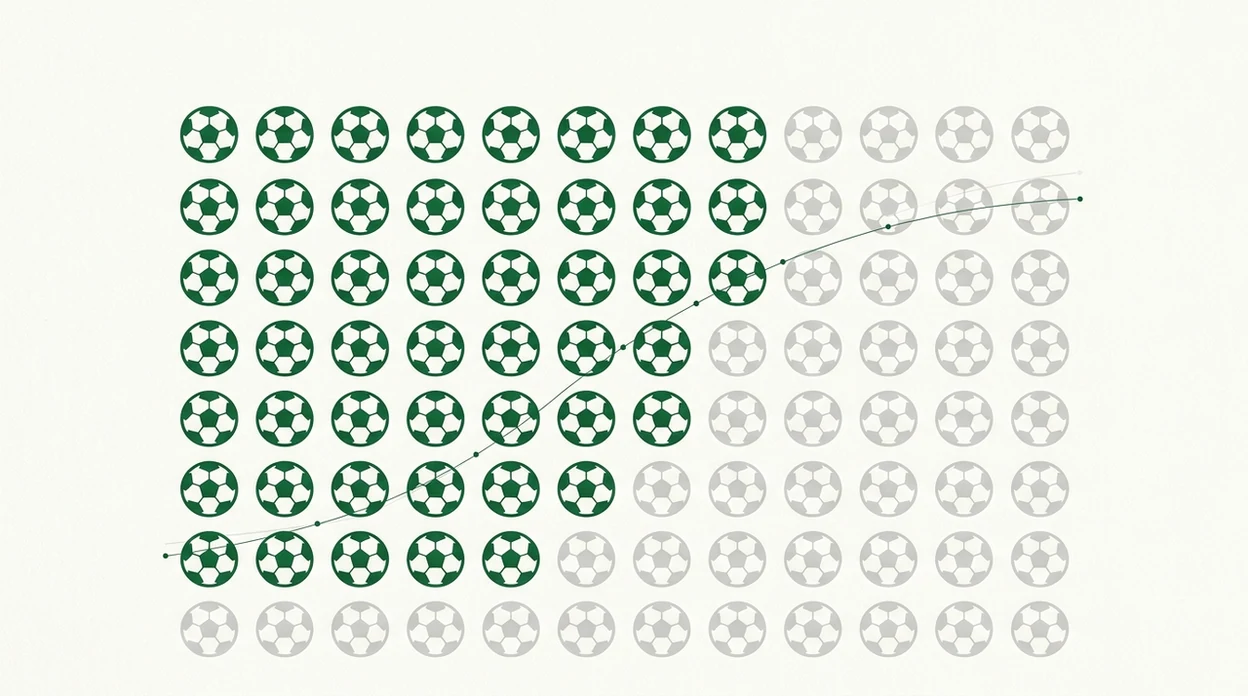
Calibration means predicted probabilities should match real outcomes over many matches. If a model gives 60% to a home win across 500 similar fixtures, about 300 home wins should occur for that probability band to be well-calibrated.
For a citable audit, pair the bucket check with a scoring rule such as Brier score, which measures how close probabilistic predictions are to the observed outcome source.
Single-match pick accuracy is noisy. A model can choose the right side today and still be badly calibrated. It can also miss a match because of a penalty and still be sound over hundreds of fixtures.
The dashboard moment we trust is not “green tick.” It is the calibration check after a data cut, where the 40%, 50%, and 60% bands are compared with observed results. Boring, but useful.
Many competitor pages focus on “who wins” and skip this step. That makes their percentages harder to audit. For football fans, a calibrated probability is often more useful than a louder pick because it shows how much uncertainty remains.
Football Goal Variance in Win Draw Loss Prediction
Football is difficult to forecast because goals are rare events. Recent Big Five league tables commonly sit in the roughly 2.5-to-3.3 goals-per-match range, which leaves one penalty, red card, or deflection with outsized influence on a 1X2 result source.
Low scoring compresses the result space. One penalty can turn 0-0 into 1-0. One red card can turn a 55% home win into a match that feels completely different after 18 minutes. The fourth official holding up the stoppage board is sometimes when the model’s neat pre-match shape meets real match chaos.
Team form also moves. A new coach, a deeper defensive block, or a winger returning from injury can create forecast drift. Hidden factors matter too: fatigue, motivation, travel, and squad rotation are only partly visible.
This is why 1X2 probabilities should be paired with goal-market context such as BTTS predictions or over 2.5 predictions, not read alone.
Examples of 1X2 Prediction Outputs
A 1X2 prediction output is read by comparing the three percentages, then judging how wide the probability gap is. The biggest number is the most likely outcome, but it is not a guaranteed result.
| Scenario | Home | Draw | Away | How to read it |
|---|---|---|---|---|
| Strong home favorite | 72% | 17% | 11% | Home win is clearly most likely, but almost 3 in 10 outcomes are not home wins. |
| Balanced match | 38% | 28% | 34% | No outcome dominates, so the confidence band should be modest. |
| Away favorite | 18% | 22% | 60% | Away win leads, but the draw remains meaningful. |
The balanced match is where casual readers often overstate certainty. A draw probability circled in red at 28% is not a side note. It is close enough to change how the forecast should be explained.
Apps such as AI Soccer Predictor can show these percentages beside score forecasts, but the 1X2 line should be read first. If you mainly care about stalemate risk, a dedicated draw prediction view is often cleaner.
How to Read a Win Draw Loss Prediction
Read a win draw loss prediction as three related probabilities, not as one headline pick. The best outcome is only the most likely result within an uncertain match, so the gap between the numbers matters as much as the leader.
- Start with the home, draw, and away percentages, then check that they add to 100%. If they do not, you may be looking at rounded numbers, an incomplete display, or a market-style figure with margin still inside it.
- Identify the highest percentage as the leading outcome, but keep the remaining probability in view. A 52% home win still leaves 48% for the draw or away win.
- Compare the first and second outcomes before calling the forecast strong. A 45-33 split is a different confidence signal from a 68-18 split.
- Check injuries, expected lineups, kickoff timing, and the update timestamp. A forecast made before team news can age quickly, especially around rotation-heavy fixtures.
- Compare the model with bookmaker implied probability only after removing the bookmaker margin. Otherwise, you are comparing a clean model percentage with a price that has overround built in.
Limitations
Win draw loss prediction cannot remove football randomness. It can organize uncertainty, but it cannot turn a low-scoring sport into a certain forecast.
- A single red card, penalty, goalkeeper error, or late injury can flip the result.
- Claims of 99% confidence are not credible for most football matches.
- Models trained on past seasons can degrade when tactics, squads, or league conditions change.
- Uncalibrated systems can make a 60% forecast behave like a 48% forecast in real results.
- AI football prediction should not be treated as a sure betting edge because market prices already reflect massive information.
- More data does not automatically create a perfect model; hidden variables still remain.
- Lineup feeds can arrive late, and one postponed match in a fixture file can distort a full slate.
The pocket check is real. Refreshing a lineup at 2:55 p.m. can be useful, but it does not erase variance.
For tournament contexts, 1X2 forecasts become only one layer inside group and knockout simulations, as shown in World Cup prediction.
FAQ
What does 1X2 mean in football?
1X2 means home win, draw, and away win. The 1 is the home team, X is the draw, and 2 is the away team.
Do 1X2 probabilities always sum to 100%?
A properly formed win draw loss prediction should sum to 100%. If the three outcomes do not total 100%, the forecast is incomplete or includes another adjustment.
Can any prediction site guarantee 90% accuracy?
No prediction site can credibly guarantee 90% accuracy across normal football 1X2 markets. Football’s low scoring and high variance make those claims misleading.
How can I predict draws more accurately?
Draws are harder to predict because they sit between the home-win and away-win extremes. League-specific draw rates and low expected goal totals are important inputs.
Is win draw loss prediction the same as exact score?
No, win draw loss prediction forecasts only the result type. Exact-score prediction estimates a specific scoreline such as 1-0 or 2-1.
What makes a 1X2 model well-calibrated?
A well-calibrated 1X2 model has predicted probabilities that match observed frequencies over many matches. A 60% forecast should win about 60% of the time in a large sample.
Are bookmaker odds the same as probabilities?
Bookmaker odds are not pure probabilities because they include margin and market pricing. Model probabilities aim to estimate the underlying match outcome chance.
Does home advantage affect 1X2 prediction?
Yes, home advantage is a major input in 1X2 prediction. Its size varies by league, season, travel pattern, and era.