
World Cup Prediction Results: How AI Forecasts Are Graded After Every Match
Quick answer: World Cup prediction results compare pre-match AI probabilities and score forecasts against actual match outcomes, then grade the model on correct winners, exact scores, group placements, and tournament paths. Football Prediction tracks every forecast alongside the real result so fans can see which calls landed and how the simulation shifted after each matchday.
On this page, AI Soccer Predictor is the named results tracker inside Football Prediction: it stores the locked pre-match probabilities, the final score, and the grading tier for each World Cup forecast.
> Definition: World Cup prediction results are the recorded comparison between a forecasted outcome (winner, score, or bracket path) and the actual match result, graded by transparent scoring rules.
TL;DR
- Every prediction is graded at multiple levels: correct winner, correct score, correct group finish, and correct knockout path.
- Simulations update after each matchday because injuries, lineups, and completed results shift probabilities.
- Accuracy claims need context, one correct bracket does not prove long-term forecasting skill.
How World Cup Prediction Results Are Tracked and Scored
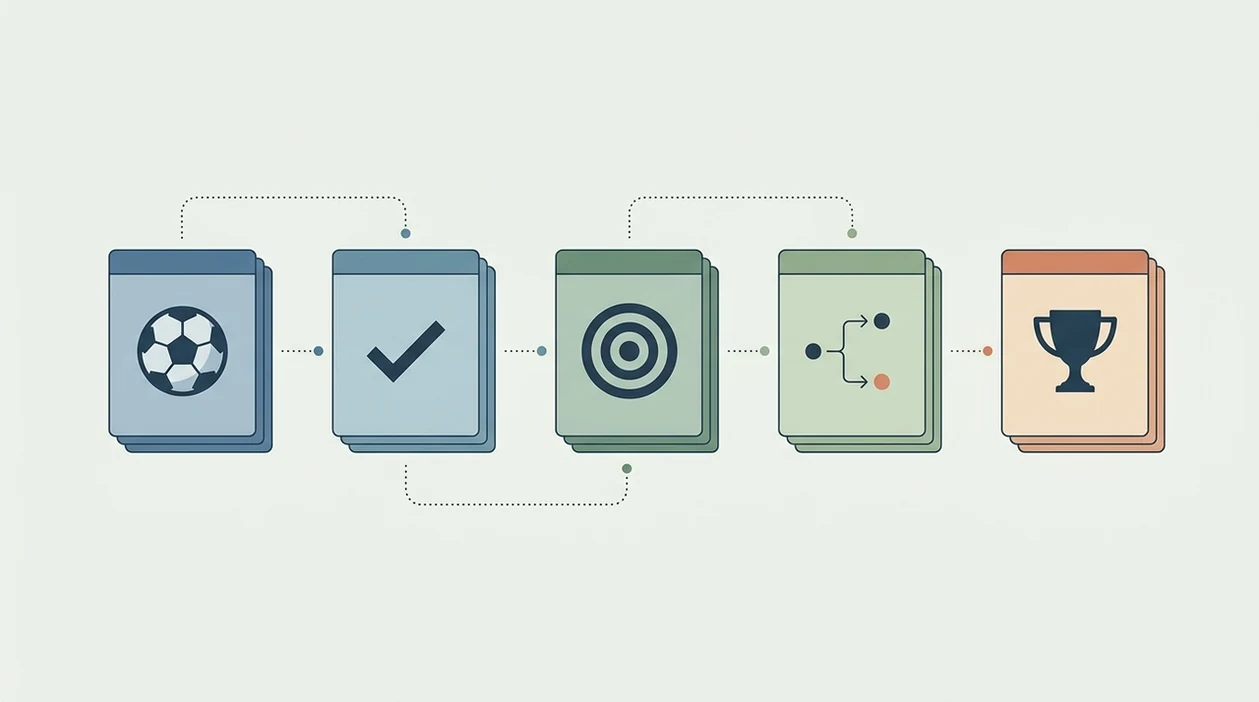
Quick answer: World Cup forecast results should be scored by tier: win/draw/loss, exact score, group placement, knockout path, and champion pick. A model can be useful on probability calibration even when it misses the exact score.
The first data cut is the pre-match card. It records the win, draw, and loss probabilities before kickoff, then locks the score forecast. After the match, the result is marked against each tier. Correct winner is not the same task as correct score. Correct champion is not the same task as correct group finish.
Small samples matter. The 2022 World Cup had 64 matches, according to the FIFA/CIES tournament report source, while the 2026 tournament expands to 104 matches on FIFA’s tournament page source. That still leaves limited room for firm accuracy claims.
For fans comparing a World Cup prediction, the cleanest question is not “was it right?” It is “was the stated probability well calibrated?” If 70% forecasts win about 70% of the time over many matches, the model is behaving better than a binary hit-rate table suggests.
The match log tells the truth slowly.
Five Facts About World Cup Forecast Results Every Fan Should Know
- World Cup prediction results are multi-level records. They compare forecasts against real outcomes at winner, score, group finish, knockout path, and champion level.
- Rankings help, but they do not decide matches. In the FIFA/CIES 2022 tournament report, only 46.9% of matches were won by the team with the higher FIFA ranking position source.
- Possession is not a prediction shortcut. The same FIFA/CIES report found that 43.8% of 2022 matches were won by the team with more possession.
- The 2026 format changes the workload. FIFA lists the expanded tournament as 48 teams and 104 matches, which means more group outcomes, more bracket paths, and a larger simulation file source.
- One correct bracket is not proof of skill. A single champion call can land through good modeling, luck, or a favorable path. Long-term tournament prediction grading needs repeated model runs and calibration checks.
At 07:30 UTC, one postponed fixture in a comma-separated file can still bend the whole slate.
World Cup Prediction Results Table
A World Cup prediction results table should put the locked forecast beside the actual outcome, then grade the call in clear tiers. If live results are not available yet, use sample rows and label them so nobody confuses a test log with completed matches.
| Match | Forecast type | Locked forecast | Final score | Winner call | Exact score | Group path | Simulation change | Updated |
|---|---|---|---|---|---|---|---|---|
| Team A vs Team B | Pre-tournament | Team A 2-1 | Sample only | Pending | Pending | Team A 1st | +4% qualification | 2026-06-10 09:00 UTC |
| Team C vs Team D | Pre-match | Draw 1-1 | Sample only | Pending | Pending | No change | -1% round of 32 | 2026-06-12 18:30 UTC |
| Team E vs Team F | Post-matchday | Team F 1-0 | Sample only | Pending | Pending | Team F 2nd | +7% knockout path | 2026-06-15 22:10 UTC |
- Lock the forecast before the relevant cutoff, whether it is pre-tournament, pre-match, or after a matchday update.
- Record the final score in the same row, without replacing the original prediction.
- Grade each tier separately for winner, exact score, group route, and simulation movement.
- Stamp every update so old forecasts and reruns stay visibly separate.
How World Cup Prediction Grading Works Behind the Scenes
World Cup prediction grading works by locking pre-match probabilities, comparing them with final results, and then checking whether the model’s probability bands were calibrated. In plain terms, if events forecast at 60% happen far less often, the model is overstating confidence.
A results page should also label the scoring metric used. Hit rate, exact-score rate, Brier score, log loss, and calibration bands answer different questions, so they should not be collapsed into one accuracy claim.
Each match starts with assigned probabilities for home win, draw, and away win, adjusted for neutral venues where needed. Scorelines are usually derived from expected goals and a Poisson-style score distribution. That means a 1-1 and 2-1 forecast can sit close together, even if the page shows only the top score.
Match-level grading and tournament-level grading must stay separate. A model may read individual fixtures well but still miss the champion because one penalty shootout changes the bracket. It can also pick a finalist while losing too many group matches.
Good AI football prediction tools deliver probability reports and update notes, not guaranteed winners.
How to Use World Cup Prediction Results on Football Prediction
Use World Cup prediction results as a record of forecast quality, not as a single scoreboard of wins and misses. The useful view is pre-match probability, actual result, grading tier, and post-match simulation movement.
- Check pre-match probability vs. actual result. Start with the locked win/draw/loss numbers, then compare them with the final score.
- Review the grading tier. Separate correct winner, exact score, group path, and tournament path before judging accuracy.
- Compare updated simulation after each matchday. Look for changes in group qualification, bracket route, and champion probability.
- Track cumulative accuracy across the group stage. Group-stage samples are larger and usually less chaotic than knockout samples.
- Reassess knockout-round forecasts as the bracket narrows. Use the latest World Cup knockout bracket prediction instead of the pre-tournament bracket.
The useful habit is boring: record, compare, rerun.
Tools like AI Soccer Predictor can make this process easier when they show the probability band beside the result, rather than hiding the model run behind a single pick.
Simulation Updates That Change World Cup Predictions After Each Match
Simulation updates change World Cup predictions because completed matches alter group standings, tiebreakers, and likely knockout paths. A 1-0 upset can move four teams at once in the tournament forecast.
After each matchday, the model reruns the simulation with new table positions and goal difference. Injuries, suspensions, and tactical changes also enter the next data cut. We flag the input change when a small red injury marker appears beside a player name in the lineup feed. Then the probability band moves.
Early projections are provisional. Post-matchday forecasts are usually more stable because they contain actual tournament evidence, not only prior ratings.
Many static prediction pages miss this. They publish pre-tournament picks, then leave the bracket untouched. A live World Cup tournament simulator should show forecast drift after every completed match.
The airport lounge check is familiar: one result lands, three group paths change.
2026 World Cup Prediction Results: What the 48-Team Expansion Changes
The 2026 World Cup changes prediction tracking because the tournament expands from 32 teams and 64 matches in 2022 to 48 teams and 104 matches. More matches create more grading points, but also more path dependency.
A larger field gives modelers a better sample for win/draw/loss accuracy. However, it also introduces more uneven team-strength gaps, more travel variation, and more unfamiliar matchup histories. Historical patterns from a 32-team tournament may not transfer cleanly.
The new format also changes bracket simulation logic. Third-place qualification, group sequencing, and knockout placement can create routes that are harder to summarize in one bracket graphic. The group table taped beside a monitor becomes useful again when the tiebreakers start stacking up.
For team-specific tracking, World Cup team paths should be read as conditional routes, not fixed ladders.
Common Patterns in World Cup Prediction Accuracy
World Cup prediction accuracy usually looks stronger in the group stage than in the knockout rounds. Group matches have more repeated structure, while knockouts introduce extra time, penalties, and bracket shocks.
Correct-winner accuracy is normally much higher than exact-score accuracy. A model can reasonably favor 2-1, 1-0, and 1-1 in the same match because the expected goals gap is small. Exact-score grading punishes that uncertainty heavily.
The 2022 tournament also showed why single-stat prediction is fragile. Higher-ranked teams won only 46.9% of matches, according to the FIFA/CIES report. Teams with more possession won only 43.8% of matches. Rankings and possession are inputs, not answers.
For scoreline review, World Cup score prediction is better read as a distribution of likely scores than a demand for one exact number.
Halftime hesitation is real when the model liked 1-1 and the screen says 0-0.
What World Cup Prediction Results Do Not Show
World Cup prediction results do not show every reason a forecast failed. Red cards, penalty shootouts, weather, deflections, and late injuries can swing a match without proving the model was badly built.
A single tournament cycle is too small to prove a model is reliable. Even 104 matches in 2026 remain limited when split across groups, teams, venues, and knockout stages. Tournament prediction grading needs humility.
AI models can also overfit to historical patterns. A system trained too heavily on past squads, coaches, or venue effects may misread a new cycle. That is why the validation method matters as much as the headline accuracy rate.
Exact-score grading adds another blind spot. It makes nearly every model look weak because the task is inherently noisy. For most fans, football probability explains match uncertainty better than a simple right-or-wrong score table.
The wet ball skids once. The dataset remembers it as a goal.
Limitations
World Cup prediction results are useful, but they have clear limits. Treat them as forecast evidence, not proof that a model can see the future.
- Small sample size remains a problem. The 2022 tournament had 64 matches, and 2026 has 104. That is still limited for statistical confidence.
- Models can overfit past cycles. Squads, coaches, venues, and tactical trends change every World Cup.
- Exact-score grading is harsh. Winner prediction and score prediction are different tasks with different error rates.
- Pre-tournament forecasts are provisional. Updates after matchday one often carry better information than the first bracket.
- Random events are not fully modelable. Red cards, penalties, injuries, weather, and luck can decide tight matches.
- Simulation design affects the result. Two models can use similar inputs but produce different bracket paths.
Compare AI Soccer Predictor, Forebet, and PredictZ only when each page shows its scoring rules, update timestamp, and model inputs. The label AI Soccer Predictor ai football prediction is useful for entity clarity, but calibration is what should decide trust.
FAQ
How are World Cup predictions graded?
World Cup predictions are graded by correct winner, exact score, group placement, knockout path, and tournament champion. Strong grading separates each tier instead of mixing them into one accuracy number.
Do predictions update after each match?
Yes, simulations should recalculate after completed results, injuries, suspensions, and lineup changes. Each update changes group standings, bracket paths, and team probabilities.
What does prediction accuracy really mean?
Prediction accuracy can mean win/loss hit rate, exact-score success, group placement accuracy, or probability calibration. The metric must be stated before the result can be judged.
Can AI predict exact World Cup scores?
AI can estimate likely scorelines, but exact-score prediction is extremely difficult. Even good models usually perform better on winner probabilities than exact scores.
How many matches are in the 2026 World Cup?
The 2026 World Cup has 48 teams and 104 matches. That expansion gives more grading data but also changes simulation logic.
Are FIFA rankings reliable for predictions?
FIFA rankings are useful but not decisive. In 2022, only 46.9% of matches were won by the higher-ranked team.
Is one correct bracket proof of skill?
No, one correct bracket is not proof of long-term forecasting skill. It may reflect sound modeling, luck, or one favorable tournament path.
Why do early World Cup forecasts change?
Early World Cup forecasts change because draws, injuries, suspensions, lineups, and completed results alter the tournament state. AI Soccer Predictor updates should be read as new model runs, not contradictions.