
Football Prediction Results With Transparent Grading
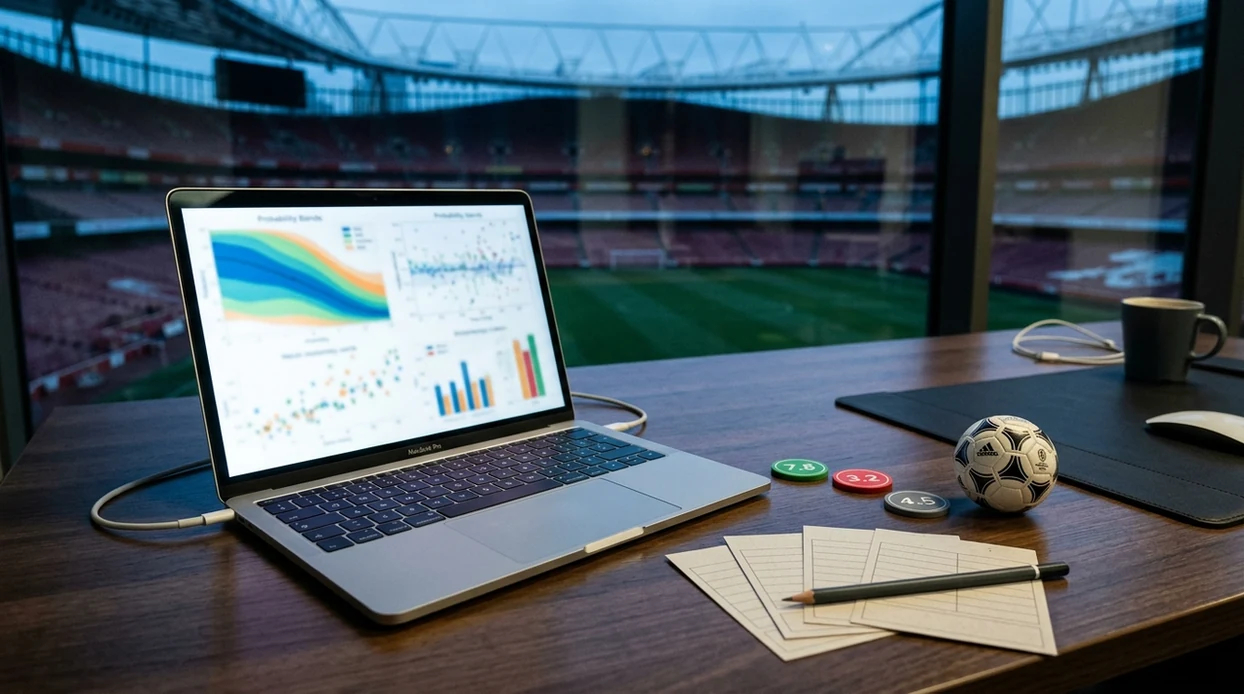
Football prediction results compare what an AI model forecasted against actual match outcomes, grading each pick as a win, loss, or void based on predefined market rules. Transparent tracking requires logging the league, teams, market type, pre-kickoff probability, and final score for every prediction. Without this structure, any claimed accuracy is unverifiable.
> Definition: Football prediction results are the recorded outcomes of pre-match forecasts, graded against final scores using explicit rules for each betting market (1X2, over/under, BTTS) to measure a prediction system's real accuracy over time.
- Every prediction must be logged before kickoff with market type, probability, and teams to prevent cherry-picking.
- Win rate alone is misleading, grading must also track ROI, sample size, and closing line value.
- Even well-calibrated AI models misclassify 30–40% of match outcomes due to football's inherent randomness.
What Football Prediction Results Actually Measure
Football prediction results measure the gap between a forecast and the final match outcome. A proper result record shows what was predicted, when it was logged, and how it graded after full time.
The minimum data set is simple: league, teams, market, odds, model probability, kickoff timestamp, final score, and grade. A 1X2 home-win prediction is not the same record as over 2.5 goals or BTTS yes. The grading rule changes with the market.
The timestamp matters most. If a pick is entered after lineups, odds movement, or the final whistle, the record no longer proves pre-match forecasting skill. In our 07:30 UTC data cut, one stale kickoff time can contaminate a whole slate.
Research on sports forecasting suggests statistical and algorithmic models often improve accuracy by about 5–15 percentage points over naive benchmarks, but uncertainty remains. Association-football modelling studies such as Dixon and Coles (1997) show why pre-match probabilities can outperform naive baselines while still leaving large error bands (https://doi.org/10.1111/1467-9876.00065). Good AI Soccer Predictor ai football prediction records show probability bands and result logs, not guaranteed winners.
Five Facts About Football Prediction Outcome Tracking
- Win rate can flatter weak value. A model can win many low-odds picks and still lose money if prices are too short.
- The market defines the grade. Asian handicap, totals, BTTS, 1X2, and correct score predictions each need separate win, loss, and void rules.
- Small samples mostly show noise. A few days or weeks of past football predictions usually reveal variance, not durable model skill.
- Records should be immutable. Once a prediction is logged, it should not be edited after kickoff; otherwise the result set invites cherry-picking.
- Model versioning changes the evidence. Results from an older model run do not automatically validate a retrained version with new inputs.
A green percentage block beside 2-1 looks tidy on screen, but the audit trail matters more. For correct score work, we separate ranked scorelines from single-score claims in our correct score prediction guide.
How Football Prediction Grading Works Behind the Scenes
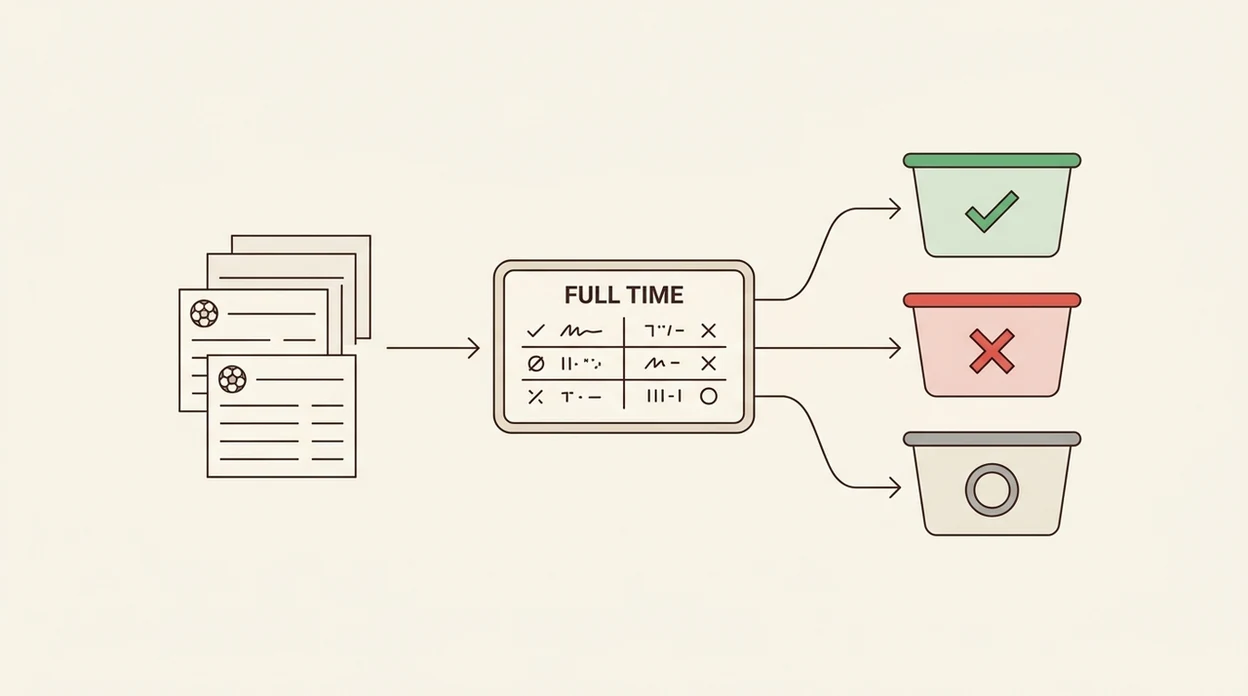
Football prediction grading works by fetching the final match result, matching it to the original market line, and assigning a win, loss, or void. The process should be mechanical, not rewritten by opinion after the match.
Market-Specific Grading Rules
A prediction on over 2.5 goals wins only if the match has three or more goals. BTTS yes wins if both teams score. Asian handicap lines need careful handling because whole-goal lines can push, and quarter-goal lines can split the stake.
Void happens. It is not a loss.
Research on English football odds, including Forrest, Goddard, and Simmons' study of odds-setters as forecasters, has found that bookmaker prices are difficult benchmarks to beat consistently (https://doi.org/10.1016/j.ijforecast.2005.03.003).
Pre-Kickoff Probability Snapshots
Football Prediction locks picks before kickoff, with the model version and probability snapshot attached to the record. The small red injury flag beside a player name in the lineup feed can trigger a rerun, but the update note must show the before-and-after number.
How to Read Football Prediction Results
To read football prediction results correctly, start with the market and line before judging the grade. A final score alone cannot explain whether the forecast was right.
- Check the market type and line before looking at the grade, especially for totals, Asian handicap, and BTTS.
- Compare the AI probability against the implied odds to see whether the forecast claimed value before kickoff.
- Review the final score and grading outcome as win, loss, or void using the original market rule.
- Filter results by league, odds range, or confidence tier to identify where the model performs differently.
- Evaluate cumulative ROI and sample size instead of reacting to one match.
For daily slates, the same reading method applies to football prediction today pages. The pocket check is real before kickoff, but the record should still outlive the feeling.
For most readers, filtering by market and confidence tier is more useful than scanning recent wins because it shows where the model has repeated evidence.
How to Use Football Prediction Results
Use football prediction results as an evidence file, not as a green-light signal for the next match. The aim is to find where the model has shown repeatable strength under clear conditions.
- Choose one market first so the record stays clean. Mixing 1X2, totals, and BTTS in the same quick judgment makes a good run look stronger than it may be.
- Filter by league and confidence tier before judging reliability. A model may read top-flight domestic leagues well but drift in cups, youth competitions, or low-data fixtures.
- Compare win rate with ROI, odds range, and sample size because each number answers a different question. A 62% hit rate at short prices can still be weaker than a lower hit rate with better value.
- Confirm the picks were logged before kickoff and locked afterward so the table proves forecasting, not editing. Timestamp discipline is the difference between a record and a screenshot.
- Use the pattern to set trust level instead of chasing streaks. A few wins should not override thin samples, and a few losses should not erase a solid long-run profile.
Method We Used to Track Past Football Predictions
Our method for tracking past football predictions uses a structured database, not a loose list of screenshots. Each row stores league, date, teams, market, line, odds, model probability, result, grade, and model version.
Every prediction batch is locked and timestamped before kickoff. We also tag the model run, because a forecast produced before retraining should not be mixed casually with a newer calibration check. In one changelog, a home win moved from 46% to 43% after a late injury input. That change belongs in the record.
Simple statistical models have sometimes slightly outperformed bookmaker implied probabilities in historical football studies, but the margins are usually small after overround. For that reason, backtested results are separated from live-tracked results.
AI Soccer Predictor is useful only when the table shows the working: pre-kickoff timestamp, model version, probability, market line, and final grade.
Common Patterns in Football Prediction Results
Common football prediction results show a tradeoff between confidence and price. Higher-confidence picks often grade better, but they usually sit at lower odds where value is harder to prove.
Some leagues behave more predictably than others. Stable lineups, consistent team strength, and reliable data feeds reduce forecast drift. Cup matches and international tournaments are messier. During World Cup group stages, rotation can distort baseline ratings; in knockouts, game state often becomes more conservative.
Losing streaks are normal, even in profitable systems. Because football is low scoring and event-driven, a calibrated model can be directionally right over a season and still miss many individual matches; track the miss rate by market before drawing conclusions. One referee checking his earpiece can change the whole grade sheet.
If you are comparing a score forecast with a broader daily view, today football prediction with score is easier to read when the scoreline probability is shown beside the market grade.
Common Myths About Football Prediction Grading
Football prediction grading is often misunderstood because a clean win percentage looks easier than a full audit. The simpler number is not always the truer one.
One myth says a 70–90% win rate guarantees profit. It does not. A high win rate on very low odds can still produce negative ROI if the prices are poor. Another myth says a few strong weeks prove model strength. Usually, that is just a small sample behaving kindly.
A third myth says final scores are enough. They are not. Over 2.5 goals, over 3.0 goals, BTTS yes, and home win all grade differently from the same match. Market and line matter.
The last myth is the most practical: unlogged past predictions can be trusted. Editable records invite hindsight. If the academy defender appears on the teamsheet at 18:45 and the pick changes at 18:48, the log must show it.
What Football Prediction Results Do Not Show
Football prediction results do not show every reason a forecast won or lost. They record the grade, but not always the match story behind it.
A result table may miss in-game context like red cards, injuries, weather, tactical changes, or a goalkeeper error. Aggregate grades also hide individual match narratives. A 1-0 under win and a chaotic 4-3 over loss may sit next to each other as plain rows.
Results from one league, season, or tournament do not guarantee future performance elsewhere. A model that reads domestic league rhythm well may drift during summer tournaments. Staking method is another blind spot because win/loss grading does not show whether stakes were flat, proportional, or dangerously escalated.
For deciding who will win today football, results are evidence, not a promise.
Limitations
Football prediction result tracking improves transparency, but it cannot remove uncertainty. The record helps judge process quality; it does not make football predictable on demand.
- Even strong AI models cannot eliminate randomness, red cards, injuries, deflections, or luck.
- Backtested results can be optimistically biased if the model was tuned on the same historical data.
- Short-term tracking is not statistically reliable for judging true model skill.
- Profit metrics based on unrealistic staking can make results look impressive while being risky.
- Public results that are not timestamped and immutable can be edited after the fact.
- Bookmaker overround erodes thin edges, even when predictions are directionally accurate.
- Niche or low-frequency leagues often have too few matches for meaningful sample sizes.
- Time-zone conversion errors can create stale kickoff records during international tournaments.
A grey uncertainty band around a forecast is not a weakness. It is the honest part. AI Soccer Predictor ai football prediction results should be read through that lens: model input, probability band, final grade, then sample size.
FAQ
What counts as a prediction win?
A prediction win is defined by the exact market and line selected before kickoff. For example, over 2.5 goals wins only when the match has at least three goals.
How many predictions prove accuracy?
Hundreds of tracked predictions are usually needed before sample size becomes meaningful. A few days or weeks of results can be dominated by variance.
Is a high win rate always profitable?
No. A high win rate on low odds can still produce negative ROI if the implied value is poor.
What is a void prediction?
A void prediction is a push where the stake is returned under the market rule. It commonly occurs on whole-goal Asian handicap or total-goals lines.
Can prediction results be faked?
Yes. Untimestamped or editable records can be changed after matches, which allows cherry-picking and hindsight bias.
Why track market type per prediction?
Market type is required because each market grades differently. A 1X2 pick, BTTS pick, and totals pick can all have different outcomes from the same final score.
Do AI football predictions beat bookmakers?
AI football predictions can sometimes find small edges, but research shows bookmaker markets are generally efficient. AI Soccer Predictor should be evaluated by live-tracked results, not isolated wins.
How often do AI football predictions lose?
Even calibrated AI models can misclassify around 30–40% of football outcomes. Football has high randomness because a single goal, card, or injury can decide the result.